Uniswap V4 Hooks for RWA Markets: Capabilities, Policies and Security Boundaries
Hooks can make pool behavior responsive to real-world market state, but every callback adds a contract whose code and authority affect users.
Key takeaways
- Uniswap V4 hooks are optional external contracts that can run at defined points in a pool's lifecycle.
- The hook address encodes which callbacks are enabled, but source and governance review are still required.
- RWA controls such as market-status logic can reduce one risk while adding oracle, admin and denial-of-service dependencies.
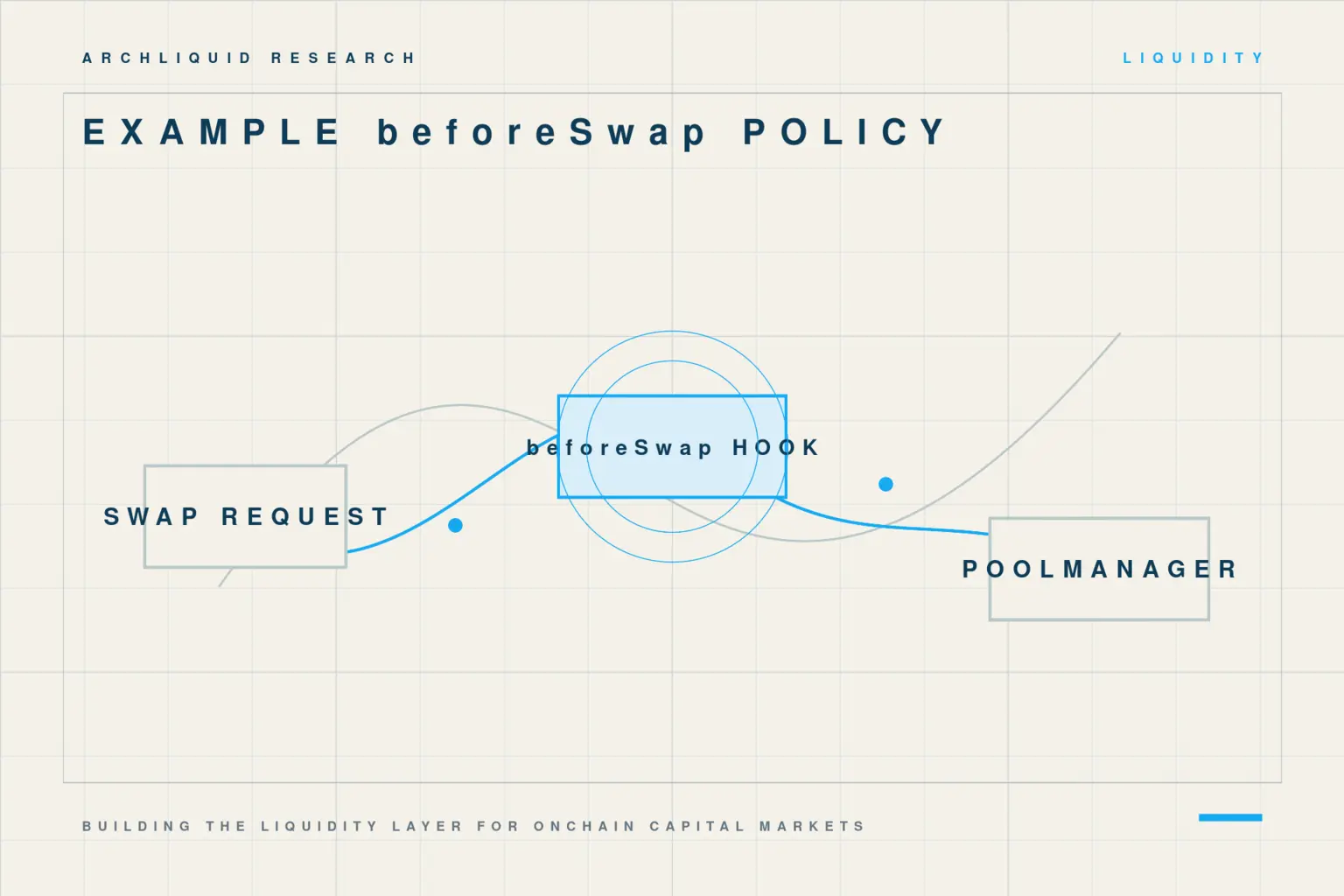
A before-swap market-status check
A hypothetical RWA pool hook reads a validated market-status source before a swap. If the underlier is halted, it rejects the swap; after recovery, it requires current data before allowing flow again.
- Callback
- beforeSwap
- Input
- Market status
- Open state
- Swap continues
- Halted state
- Swap reverts
One of the lifecycle points documented for V4 hooks.
Hypothetical validated data dependency.
PoolManager performs the swap under pool rules.
Introduces availability and governance tradeoffs.
The market-status hook is an architectural example, not a claim about a deployed Robinhood Chain pool.
Source: Uniswap V4 hooks (Uniswap Developers).
Hooks are pool-specific extension contracts
Uniswap V4 allows a pool to be created with an optional hook contract. The hook can receive callbacks around initialization, liquidity changes, swaps and donations, depending on permissions encoded in its address. One hook is associated with a pool, so its behavior becomes part of that pool's market design.
A hook is not a plugin that users can ignore after selecting the same token pair. Two pools with identical currencies and fees can behave differently because their hooks execute different logic. Interfaces should treat the hook address as a primary pool identity field.
RWA markets have tempting hook use cases
A hook could adjust fees, check market status, enforce a participant policy or record custom observations. Tokenized-stock markets may want different behavior during reference-market hours, halts or high volatility. Implementing those rules close to execution can make policy consistent across interfaces.
The same design also imports new dependencies. A market-status hook can fail when its data source is unavailable. A permissions hook can block legitimate exits if its registry is wrong. Dynamic-fee logic can be manipulated if its measurements are weak. Each feature needs a threat model and a recovery path.
Address flags reveal callbacks, not correctness
V4 encodes hook permission flags in the hook contract address. Pool creation validates those flags against the declared callbacks. This makes enabled lifecycle points machine-readable, but it does not prove what the callback code does or who can change its dependencies.
Review verified source, runtime bytecode, constructor inputs and administrative roles. If the hook uses a proxy, trace the implementation and upgrade authority. A familiar pool interface cannot compensate for an unreviewed hook with broad external calls.
Locker policy must account for the hook
A V4 position locker cannot treat every position manager NFT as economically equivalent. Hooked pools can alter liquidity and swap behavior, so a locker may support only hookless pools or maintain an explicit allowlist of reviewed hook code hashes and configurations.
Fee collection requires V4-specific handling through position-manager actions and must preserve principal liquidity. Transferring a position can also affect subscriber state. Custody receipts should record pool key, hook address, manager and liquidity so later operations remain bound to the reviewed object.
Release with observable invariants
Tests should cover every enabled callback, unexpected reverts, reentrancy, stale data, admin changes and zero-liquidity paths. Fuzz tests can assert that fee collection does not reduce principal and that unsupported hooks cannot enter custody. Mined testnet flows should complement local tests for the exact manager deployment.
Public support should name the network, pool manager and accepted hook policy. Calling V4 generally supported without those constraints hides the largest behavioral difference from earlier versions. Precise release gates let experimentation continue without presenting every possible hook as reviewed.
Sources and further reading
Sources were accessed for this publication on August 4, 2026. Product terms, networks and deployments can change; check the linked primary source before acting.
Related reading
Uniswap V2, V3 and V4 on Robinhood Chain: A Liquidity Provider Guide
V2 LP tokens, V3 position NFTs and V4 hook-enabled positions can all represent liquidity, but they require different custody and risk controls.
Liquidity Locks for RWA Markets: What They Prove and What They Do Not
A valid lock proves that a defined position cannot be withdrawn before a timestamp. It does not prove price stability, asset backing or market quality.
Impermanent Loss for Stock-Token AMMs: Formula, Example and Risk Drivers
A stock token rising against its quote asset leaves a passive pool holding less of the outperforming side. Fees can offset that difference, but not by definition.