Uniswap V2, V3 and V4 on Robinhood Chain: A Liquidity Provider Guide
V2 LP tokens, V3 position NFTs and V4 hook-enabled positions can all represent liquidity, but they require different custody and risk controls.
Key takeaways
- V2 positions are fungible ERC-20 LP tokens; V3 and V4 positions are non-fungible and pool-specific.
- A locker must validate the canonical factory or position manager rather than trusting the asset interface alone.
- V4 hooks and subscriber behavior create additional policies that a V3-only locker does not address.
One liquidity goal, three different custody objects
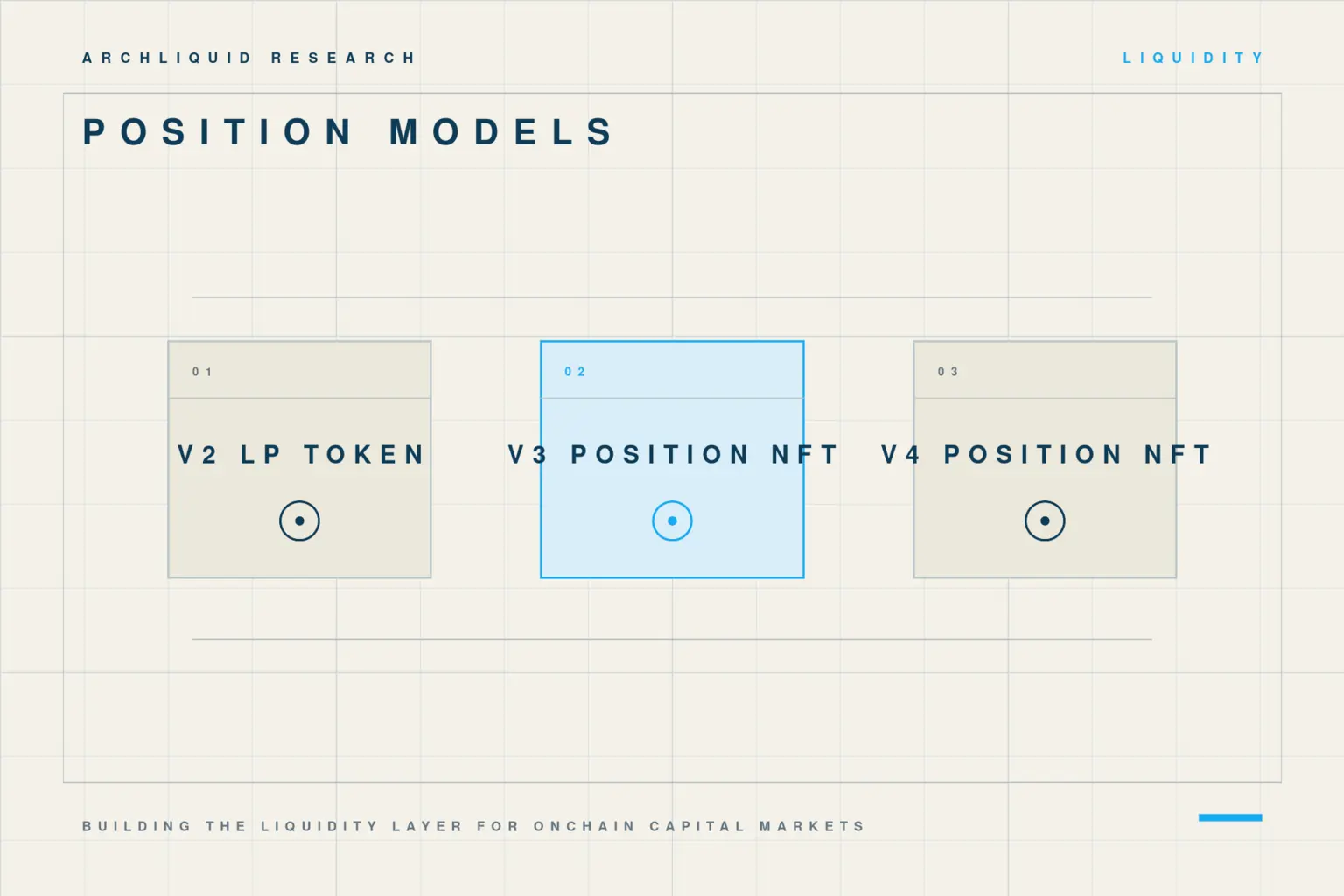
The interface a locker receives changes by protocol version. V2 transfers a fungible pair token; V3 and V4 transfer unique positions, while V4 adds hook and subscriber considerations.
- Uniswap V2
- ERC-20 LP token
- Uniswap V3
- ERC-721 position
- Uniswap V4
- PositionManager NFT
- Locker invariant
- Principal stays locked
Validate the pair against the canonical factory.
Range, liquidity and fees are position-specific.
Hooks and subscriber removal require additional policy.
Fee collection must not reduce position liquidity.
Source: Uniswap protocol deployments (Uniswap Developers).
Three versions, three position models
Uniswap V2 represents a liquidity provider's share of a pool with a fungible ERC-20 LP token. Each canonical pair is created by a factory, and ownership of LP tokens corresponds to a proportional claim on the pair's reserves. The model is simple to custody because an LP position moves with a standard token transfer.
Uniswap V3 introduced concentrated liquidity. A provider chooses a price range, so positions in the same pool can have different ranges, liquidity and accrued fees. Those unique positions are represented as NFTs. V4 keeps non-fungible position management while moving pools into a singleton PoolManager and adding hooks that can run custom logic around pool actions.
Official Robinhood Chain deployments
Uniswap's official V2 deployments page lists a Robinhood Chain factory and Router02. The official V4 deployment material lists the Robinhood Chain PoolManager and related periphery. Canonical deployment pages are the starting point for identity; copying an address from a social post or token interface is not sufficient.
Network scope must stay explicit. A mainnet deployment address can have no code on testnet, and an undocumented testnet contract can differ from the mainnet bytecode even when it exposes similar functions. ArchLiquid therefore separates mainnet compatibility research from testnet release support instead of treating a shared address as shared provenance.
Why V2 locking is mechanically simpler
A V2 locker can hold LP tokens with ordinary ERC-20 custody. The important security check is not whether the candidate responds like a token; a fake ERC-20 could imitate an LP asset. A canonical locker should read the pair's factory and tokens, then confirm that the configured factory returns that exact pair for those tokens before accepting the transfer.
Wallet discovery also needs discipline. An indexer can identify ERC-20 balances, but the application should reconcile each candidate against the canonical factory and the wallet's current balance. Historical transfer events or token metadata alone are not proof that the user currently holds an official LP position.
V3 positions require NFT-aware custody
A V3 position locker receives an NFT and records the original owner, unlock time and position manager. Fee collection and principal withdrawal are separate operations. The locker must allow the owner to collect earned fees without creating a path to decrease liquidity before maturity.
Position discovery cannot depend on ERC-721 Enumerable because position managers are not required to implement it. A practical interface reads an indexed NFT ownership surface and verifies every token ID with the manager's current ownerOf result. This avoids showing burned, transferred or stale positions.
Why V4 needs a dedicated locker
V4's NFT transfer operations resemble V3, but fee collection does not. The official PositionManager guide explains that there is no standalone collect command. Fees are collected through a zero-liquidity decrease action followed by a take action. A safe locker should compare liquidity before and after the call and revert if principal changed.
Hooks add another boundary. Hookless pools have the most predictable base behavior; hooked pools can execute custom code and should require an explicit approval policy. Transferring a V4 position also removes its existing subscriber, so a custody interface must disclose that state change. These differences are enough to make reusing a V3 locker unsafe even when both positions are NFTs.
What ArchLiquid supports today
ArchLiquid's Robinhood Chain testnet release supports deployed V2 LP-token, V3 position-NFT and V4 position-NFT lockers. V2 uses a pinned upstream Uniswap V2 factory and router fixture with canonical-pair validation. V4 pins one PositionManager, permits hookless pools by default and checks that fee collection preserves position liquidity.
The V2 and V4 transaction controls are enabled from a signed module manifest only after the exact deployed bytecode, immutable wiring, ownership and release signature pass independent live-chain checks. The V4 testnet addresses and runtime hashes are recorded explicitly because Uniswap's public deployment page does not currently list Robinhood testnet and the observed PositionManager bytecode differs from Robinhood mainnet.
Sources and further reading
Sources were accessed for this publication on August 4, 2026. Product terms, networks and deployments can change; check the linked primary source before acting.
Related reading
Liquidity Locks for RWA Markets: What They Prove and What They Do Not
A valid lock proves that a defined position cannot be withdrawn before a timestamp. It does not prove price stability, asset backing or market quality.
Impermanent Loss for Stock-Token AMMs: Formula, Example and Risk Drivers
A stock token rising against its quote asset leaves a passive pool holding less of the outperforming side. Fees can offset that difference, but not by definition.
Concentrated Liquidity for Tokenized Stocks: Ranges, Capital Efficiency and Gaps
A narrow liquidity range can quote efficiently near an expected stock price, then become entirely inactive when the market moves beyond it.