Impermanent Loss for Stock-Token AMMs: Formula, Example and Risk Drivers
A stock token rising against its quote asset leaves a passive pool holding less of the outperforming side. Fees can offset that difference, but not by definition.
Key takeaways
- For an equal-value constant-product position, price ratio r gives value ratio 2√r/(1+r) before fees.
- A two-times relative price move produces about 5.72% impermanent loss compared with holding the assets.
- Stock-token pools add market-hour, oracle, settlement-asset and wrapper-redemption risks beyond the AMM formula.
A two-times relative price move creates about 5.72% impermanent loss
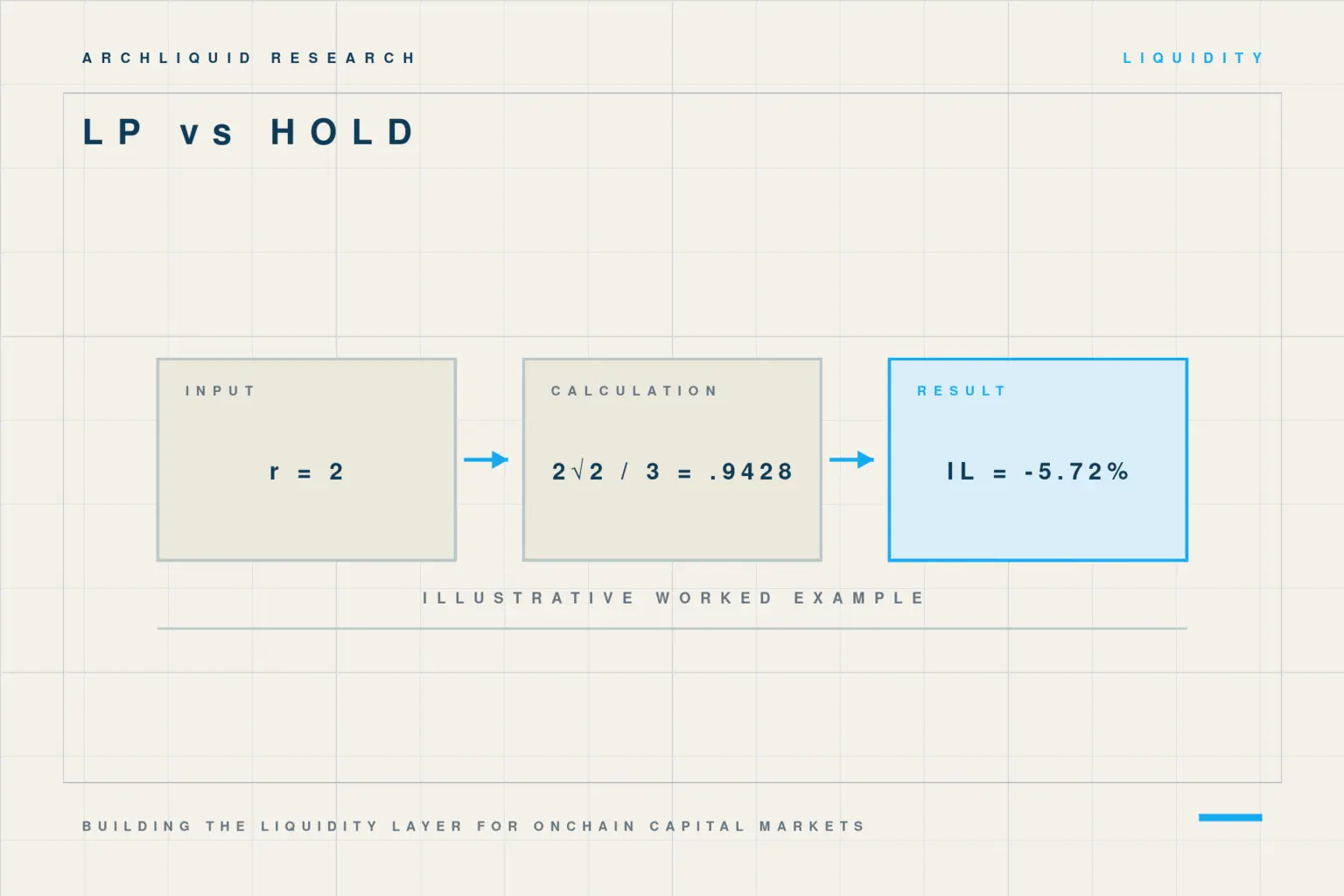
For a simplified equal-value V2-style position with no fees, use r = 2. The LP-to-hold value ratio is 2√2/(1+2) ≈ 0.9428, so the difference is approximately -5.72%.
- Relative price ratio
- r = 2
- Value ratio
- 2√2 ÷ 3 = 0.9428
- Impermanent loss
- 0.9428 - 1 = -5.72%
- Not included
- Fees and market frictions
Stock token doubles against the quote asset.
LP value divided by buy-and-hold value before fees.
Difference relative to holding both starting assets.
Actual result depends on volume, routing, range and asset behavior.
Illustrative V2-style calculation before fees. It is not a forecast or a live pool result.
What impermanent loss compares
Impermanent loss compares the value of an automated-market-maker position after a relative price change with the value of simply holding the starting assets. Arbitrage changes the pool's reserves as outside prices move. The provider ends with more of the relatively weaker asset and less of the stronger one.
The word impermanent describes the possibility that relative prices return, not the absence of economic loss. Withdrawing realizes the current difference, and a token wrapper or quote asset can experience permanent impairment. Fees earned by the pool are a separate return that can offset or exceed the difference.
Use the ratio, not the dollar direction
For an equal-value constant-product position, a common pre-fee comparison is 2 times the square root of r, divided by one plus r, where r is the ending relative price divided by the starting relative price. The result is symmetric for reciprocal moves: doubling and halving create the same percentage difference.
The formula assumes a simple full-range constant-product pool, no fees and assets whose values can be compared consistently. Concentrated liquidity, dynamic fees and hooks change the path. They do not eliminate the need to compare the LP strategy with a stated alternative.
Stock-token markets can gap
A public stock can open far from its prior close after earnings or material news. The blockchain may have allowed transfers while the reference market was closed. When a new reference price appears, arbitrage can move a thin pool quickly and passive liquidity providers can absorb informed flow.
Trading halts create a similar information gap. A pool continues to calculate from reserves even when the reference venue has stopped price discovery. Providers need market-status monitoring and a deliberate decision about whether to remain active through those windows.
Fees are compensation, not certainty
Fee income depends on actual volume that crosses the position and the protocol's fee rules. High volume can compensate for inventory rebalancing; toxic flow can produce losses larger than fees. Report annualized fee percentages with the observation window, capital base and out-of-range time.
A stock-token pool also bears quote-asset and wrapper risk. A stablecoin depeg changes the relative price for reasons unrelated to the stock. A redemption restriction can create a persistent token discount that arbitrage cannot close.
Evaluate the complete LP position
Before providing liquidity, inspect canonical contracts, pool depth, fee tier, concentration, market hours and exit routes. Understand whether the stock token can be created or redeemed and whether the quote asset has a robust settlement path. A familiar ticker does not make either side risk-free.
Track results against a defined benchmark using current claimable assets plus fees, not a dashboard percentage alone. Preserve starting amounts and timestamps. That turns impermanent-loss discussion from a generic warning into a calculation that can be reproduced for the actual position.
Sources and further reading
Sources were accessed for this publication on August 4, 2026. Product terms, networks and deployments can change; check the linked primary source before acting.
Related reading
Uniswap V2, V3 and V4 on Robinhood Chain: A Liquidity Provider Guide
V2 LP tokens, V3 position NFTs and V4 hook-enabled positions can all represent liquidity, but they require different custody and risk controls.
Liquidity Locks for RWA Markets: What They Prove and What They Do Not
A valid lock proves that a defined position cannot be withdrawn before a timestamp. It does not prove price stability, asset backing or market quality.
Concentrated Liquidity for Tokenized Stocks: Ranges, Capital Efficiency and Gaps
A narrow liquidity range can quote efficiently near an expected stock price, then become entirely inactive when the market moves beyond it.