Liquidity Locks for RWA Markets: What They Prove and What They Do Not
A valid lock proves that a defined position cannot be withdrawn before a timestamp. It does not prove price stability, asset backing or market quality.
Key takeaways
- The lock must custody the canonical position and enforce maturity onchain.
- Owner-controlled fee collection can be safe only when principal cannot decrease.
- A lock does not verify backing, prevent impermanent loss or guarantee buyers an exit.
What a 180-day 100% LP lock proves-and what it does not
Assume a project deposits all 1,000 LP tokens it controls into a locker for 180 days. The public can verify custody and the unlock timestamp, but the lock does not prove the underlying pool is deep or fairly priced.
- LP balance deposited
- 1,000 LP
- Lock share
- 100%
- Duration
- 180 days
- Still unproven
- Market quality
Illustrative amount; verify against the wallet's total controlled supply.
100% of the stated project-controlled balance, not necessarily all LP supply.
The unlock timestamp is enforced by the custody contract.
Price, depth, token rights and issuer solvency remain separate questions.
Illustrative numbers only. A lock receipt should be reconciled with the canonical pool and current LP-token supply.
The exact promise of a liquidity lock
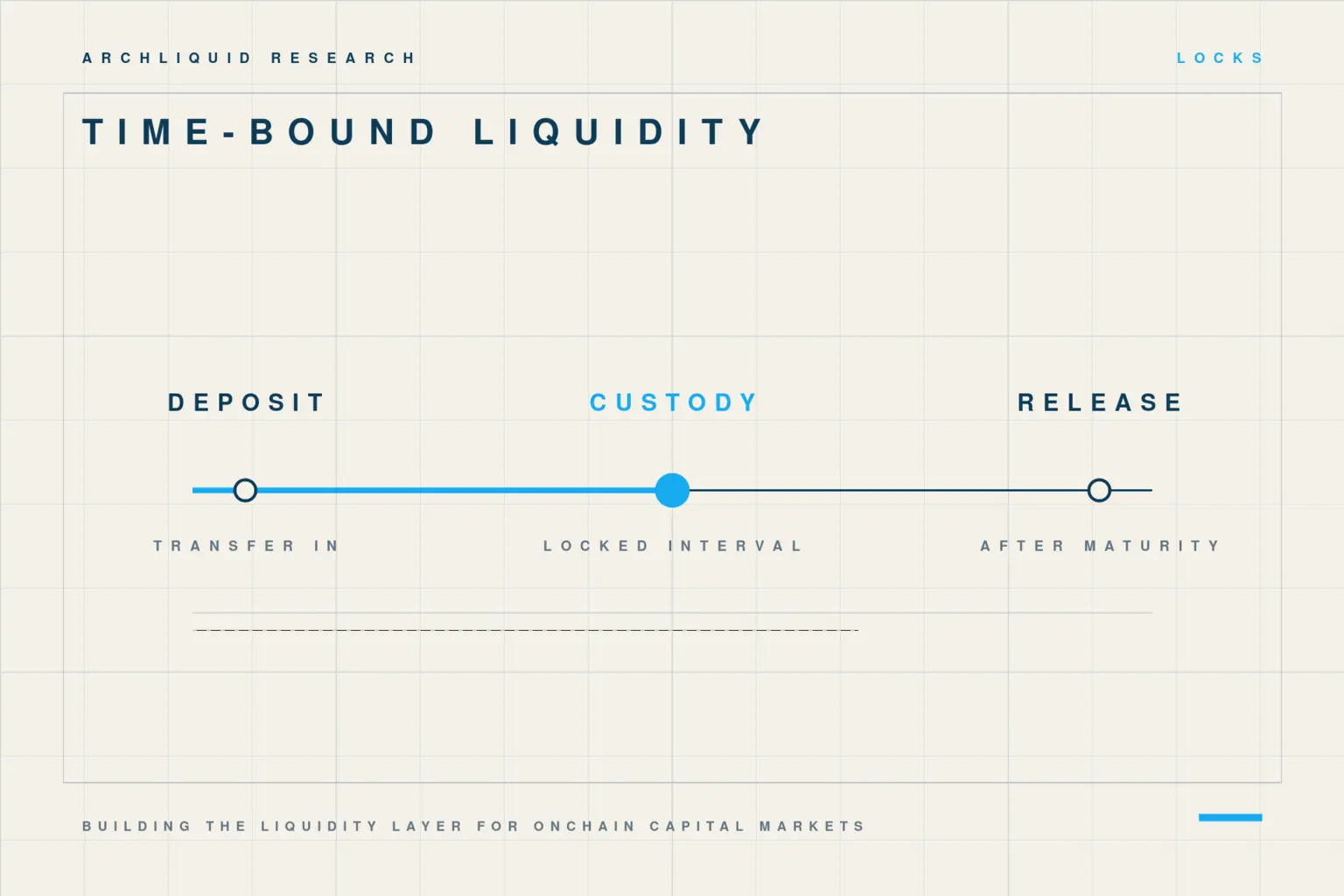
A liquidity lock is an onchain custody rule for an LP token or position NFT. The position moves into a contract, the contract records an owner and unlock time, and withdrawal reverts until maturity. Anyone can inspect the owner, asset, timestamp and eventual withdrawal transaction.
That is a narrow but valuable promise. It addresses the risk that a position owner immediately removes committed liquidity. A serious locker does not market the lock as a guarantee of token value or market depth because neither follows from custody alone.
Canonical position validation
The locker must prove it received the intended position. A V2 LP-like ERC-20 can be forged, so the contract validates the immutable factory and canonical pair. V3 and V4 lockers bind to an immutable position manager and accept NFTs only through the expected lock flow.
Front-end labels do not secure direct contract calls. Validation belongs in the custody contract, before fees and transfers become final. Wallet discovery can use an indexer for convenience, but every candidate should be reconciled with current balances or ownerOf before the interface offers it for locking.
Fees without principal withdrawal
Position NFTs can accrue trading fees while locked. Letting the recorded owner collect those fees can preserve the economic usefulness of a long lock, but the operation must not lower liquidity. V3 and V4 use different position-management calls, so safe implementations need version-specific logic.
For V4, fee collection uses a zero-liquidity decrease plus a take action. A locker can record liquidity before the call and require an identical value afterward. This turns a design intention into an enforceable invariant. A generic arbitrary-call function would be much harder to reason about and could expose principal.
What a lock does not prove
A locked pool can still be thin, imbalanced or outside the active price range. Its assets can fall in value. The stock token can carry issuer or custody risk, and the settlement asset can depeg. A malicious project can hold additional unlocked supply or use a different pool. None of those conditions is cured by one locked position.
Locks also do not prevent impermanent loss or adverse selection. During a reference-market halt, informed traders may trade against a stale pool. After maturity, the owner can withdraw unless a new lock is created. Users should read the amount, pool identity, range, owner and exact unlock time rather than relying on a badge alone.
Evidence a trustworthy interface should show
A useful lock page links to the locker and position manager, identifies the canonical pool, displays current owner and maturity, and reads those values from chain. It distinguishes testnet from mainnet and reports whether the locker source matches the deployed bytecode. If a module is not deployed, the transaction controls remain disabled.
For RWA markets, the page should also link to canonical token identity and disclose the limits of the proof. Good security communication describes what a contract enforces in one sentence and lists the important risks outside that sentence.
Sources and further reading
Sources were accessed for this publication on August 4, 2026. Product terms, networks and deployments can change; check the linked primary source before acting.
Related reading
Uniswap V2, V3 and V4 on Robinhood Chain: A Liquidity Provider Guide
V2 LP tokens, V3 position NFTs and V4 hook-enabled positions can all represent liquidity, but they require different custody and risk controls.
Impermanent Loss for Stock-Token AMMs: Formula, Example and Risk Drivers
A stock token rising against its quote asset leaves a passive pool holding less of the outperforming side. Fees can offset that difference, but not by definition.
Concentrated Liquidity for Tokenized Stocks: Ranges, Capital Efficiency and Gaps
A narrow liquidity range can quote efficiently near an expected stock price, then become entirely inactive when the market moves beyond it.