Concentrated Liquidity for Tokenized Stocks: Ranges, Capital Efficiency and Gaps
A narrow liquidity range can quote efficiently near an expected stock price, then become entirely inactive when the market moves beyond it.
Key takeaways
- Concentrated-liquidity positions earn swap fees only while the market price is inside their active range.
- Narrow ranges improve capital efficiency near the current price but increase rebalancing and gap risk.
- Tokenized-stock providers must account for reference-market sessions, halts and wrapper-specific price divergence.
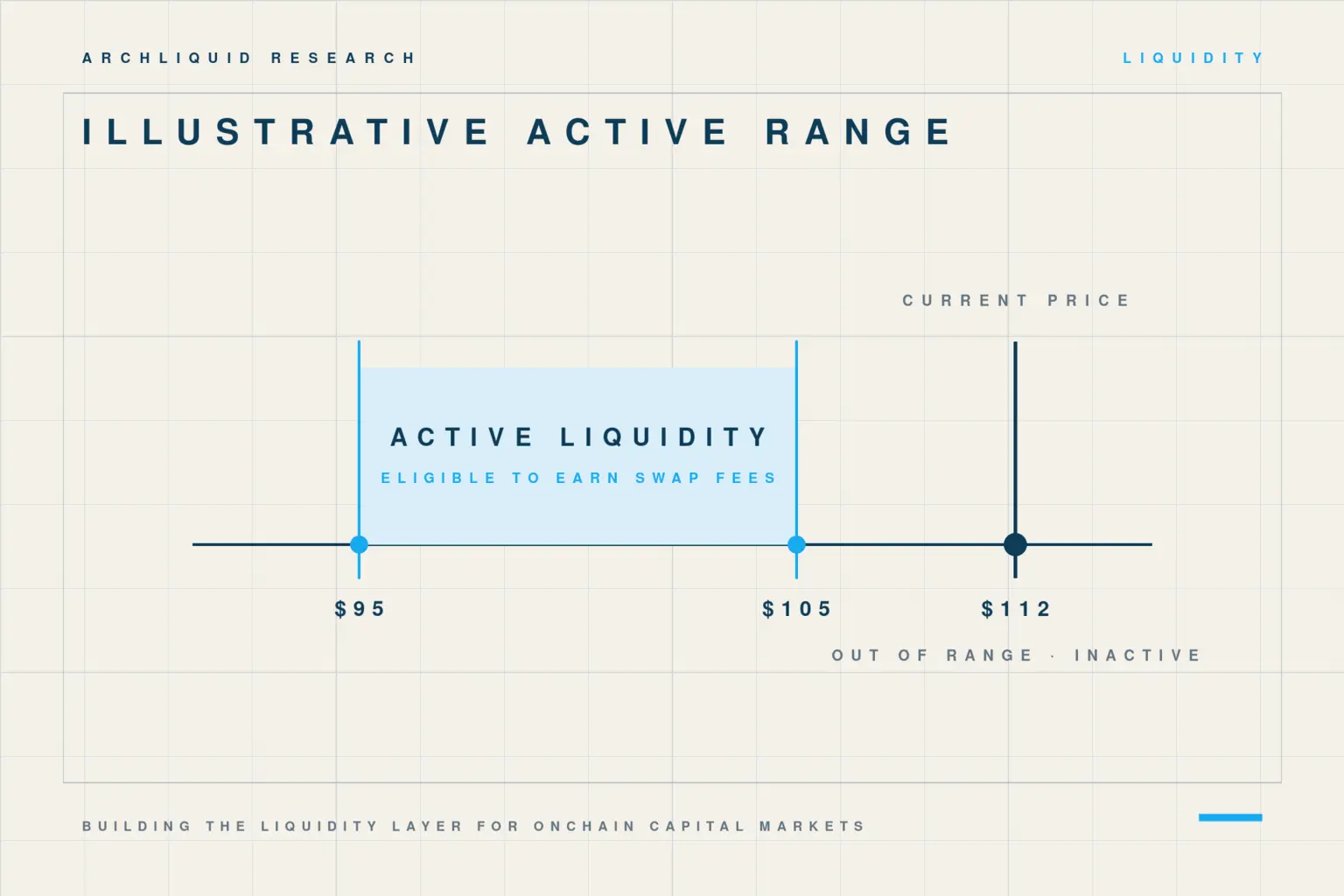
A $95-$105 position is inactive after a move to $112
Assume a hypothetical tokenized stock is priced at $100 when liquidity is placed from $95 to $105. If the pool moves to $112, the position is outside its range and no longer earns swap fees until price returns or the owner repositions it.
- Entry price
- $100
- Active range
- $95-$105
- New pool price
- $112
- Position state
- Out of range
Hypothetical pool price when the position is created.
Capital is concentrated inside this illustrative band.
Position has crossed the upper boundary.
Inactive for fee earning until price returns or liquidity is repositioned.
Illustrative prices only. Real positions use ticks and pool-specific token ordering.
Source: Concentrated liquidity (Uniswap Developers).
Concentration changes where capital works
Uniswap V3 and V4 let liquidity providers choose price ranges. Capital inside the active range participates in swaps and earns fees. Capital outside the range is inactive. This can create much more depth near an expected price than spreading the same assets across every possible price.
The benefit comes with management risk. A position can move entirely into one asset and stop earning when price crosses its boundary. The NFT still exists and can still be locked, but the economic liquidity it provides to the current market can be zero.
Stock prices create session and gap risk
Tokenized stocks reference securities whose primary markets have sessions, halts and discontinuous openings. A narrow onchain range placed before a company announcement can be crossed when new reference pricing arrives. The provider may not have had a continuous opportunity to reposition around the move.
Twenty-four-hour token transfer does not remove this risk. During the closed session, onchain price can reflect expectation and thin liquidity. At reopening, arbitrage can rapidly consume positions that were set around the prior close.
Ranges are encoded as ticks
Concentrated-liquidity protocols discretize price into ticks. Pool fee settings constrain which ticks can be used. Interfaces translate human prices into tick boundaries while accounting for token order and decimals. A reversed token order can invert a range and confuse users if labels are not explicit.
Before signature, show lower and upper price in recognizable units, current pool price and whether the position begins active. Contract calls should use quoted parameters with slippage and deadline controls. A preview must be refreshed if chain or pool state changes.
Fee yield needs an active-capital denominator
A narrow range can earn a large fee percentage while active, but annualizing a short burst can mislead. Reports should show time in range, fees by token, current inventory and the value benchmark. Uncollected fees and principal are distinct even when one interface displays them together.
Locking a position does not make it continuously useful. A project can lock a V3 NFT whose range is far from market. Public lock views should therefore display range and current active status rather than treating custody duration as a complete measure of liquidity quality.
Custody must preserve principal
A position locker receives the NFT and prevents transfer or liquidity decrease until maturity. It can optionally allow fee collection if the contract proves that principal liquidity does not change. The canonical position manager and original owner should be fixed in the receipt.
Wallet discovery needs current owner verification because position managers need not provide enumerable ownership. Indexers can find candidate token IDs, but onchain owner reads settle current state. That same reconciliation prevents transferred, burned or stale positions from appearing selectable.
Sources and further reading
Sources were accessed for this publication on August 4, 2026. Product terms, networks and deployments can change; check the linked primary source before acting.
Related reading
Uniswap V2, V3 and V4 on Robinhood Chain: A Liquidity Provider Guide
V2 LP tokens, V3 position NFTs and V4 hook-enabled positions can all represent liquidity, but they require different custody and risk controls.
Liquidity Locks for RWA Markets: What They Prove and What They Do Not
A valid lock proves that a defined position cannot be withdrawn before a timestamp. It does not prove price stability, asset backing or market quality.
Impermanent Loss for Stock-Token AMMs: Formula, Example and Risk Drivers
A stock token rising against its quote asset leaves a passive pool holding less of the outperforming side. Fees can offset that difference, but not by definition.