Tokenized Stock Dividends and Corporate Actions: What Applications Must Track
A price feed does not tell a holder whether a dividend is owed. Distribution rights, record dates and payment rails come from the instrument's terms and lifecycle data.
Key takeaways
- Dividend treatment depends on the product terms; economic price exposure does not automatically grant shareholder distributions.
- Applications need instrument identity, record and payment dates, entitlement rules, currency and distribution status.
- Reconciliation should connect upstream action data, eligible balances and the final payment or non-payment result.
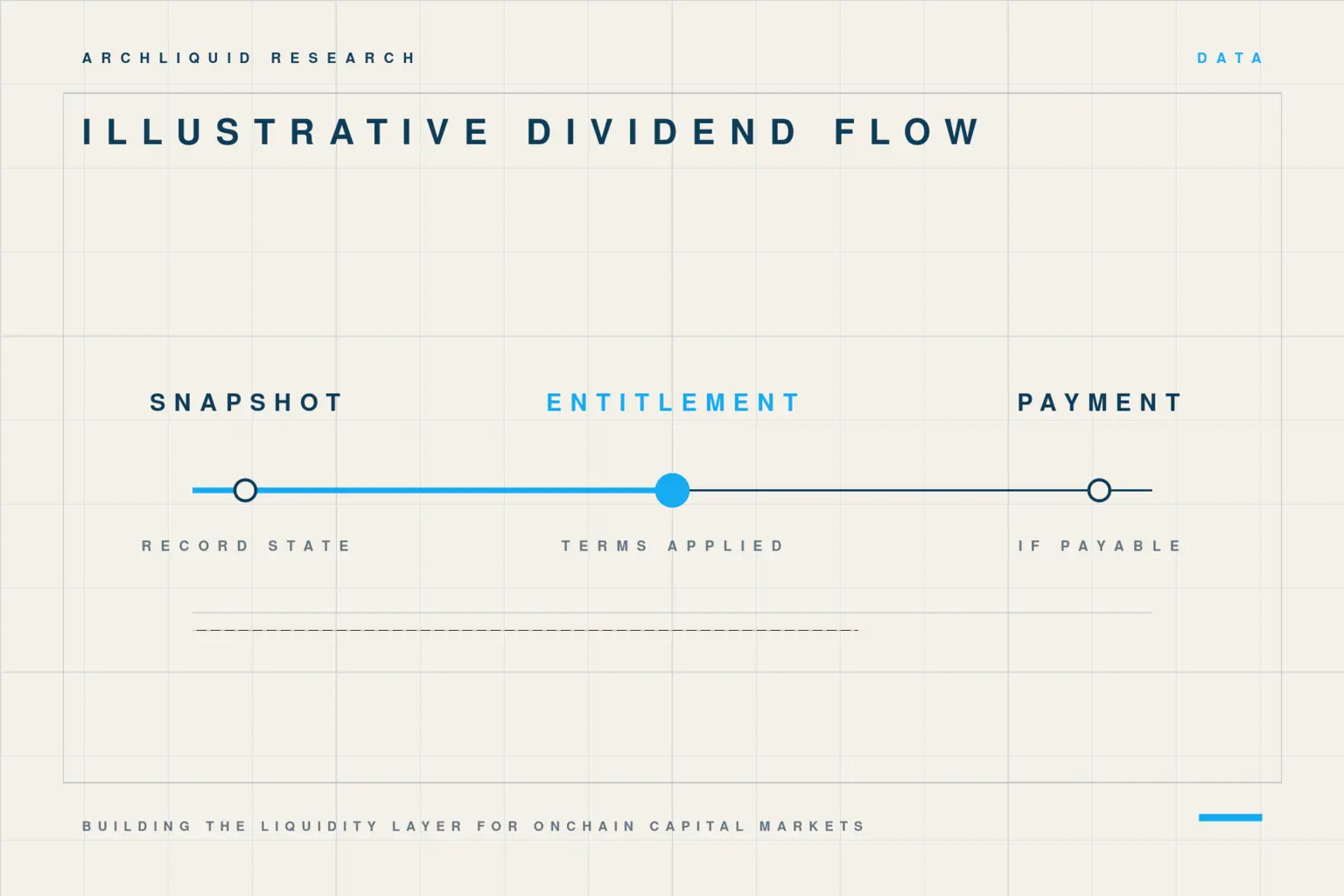
A record-date snapshot, not today's balance, determines the example payment
Assume terms pass through a $0.25 cash dividend and a wallet is eligible for 80 units at the record-date snapshot. The gross illustrative entitlement is $20 before any tax, fee or currency treatment.
- Eligible units
- 80
- Dividend per unit
- $0.25
- Gross entitlement
- $20.00
- Required evidence
- Terms + snapshot + payment
Hypothetical record-date balance under assumed pass-through terms.
Illustrative declared amount.
80 × $0.25, before deductions or conversion.
All three are needed to explain the final result.
All values are illustrative. Whether a Stock Token pays dividends and how it does so depends on its governing terms.
Price exposure is not a dividend promise
A token can track a public company's share price without granting legal ownership of that share or a direct claim on its dividends. The SEC's tokenized-securities taxonomy separates issuer-sponsored instruments from unaffiliated third-party structures. Robinhood's product material likewise describes specific Stock Tokens through their own terms rather than making every tokenized share representation equivalent.
An interface should therefore answer the rights question before calculating an amount. Does the issuer pass through cash distributions, reinvest them, incorporate them into a derivative payoff or provide no distribution at all? A chart that follows an underlying stock cannot answer that legal and operational question.
Model the corporate-action record
A useful dividend object includes the canonical instrument, action identifier, declaration date, ex-date, record date, payment date, amount per unit, currency and status. Source timestamps and revisions matter because actions can be corrected. Store upstream fields alongside normalized fields so a reviewer can reconstruct the transformation.
The instrument key should include the token deployment or stable product identifier, not only a ticker. Corporate actions can differ across classes and product wrappers that share a familiar symbol. Applying an event to the wrong contract can create an entitlement where the governing terms provide none.
Snapshot eligibility at the correct time
Traditional corporate actions use defined market dates. A continuously transferable token adds time-zone, block-time and intermediary questions. The issuer's terms must specify the balance or record system used for eligibility and how pending bridge or venue balances are treated.
A wallet balance observed today is not proof of the balance at the record moment. If onchain snapshots participate, record the block number and chain. If an offchain issuer ledger controls entitlement, expose that distinction. Reorg and finality policy should be resolved before a snapshot becomes irreversible.
Calculate and distribute transparently
Gross entitlement is usually units multiplied by an amount per unit, but final payment can involve withholding, fees, fractional rounding and currency conversion. Each adjustment needs a named rule and value. Combining them into a single unexplained net number makes support and independent reconciliation difficult.
Distribution can happen through an onchain token transfer, an offchain account credit or another contractual mechanism. The payment rail should not be implied by the asset's blockchain format. Show pending, paid, failed and ineligible states, with transaction or ledger references appropriate to the actual route.
Reconcile rather than merely notify
A notification that a dividend occurred is not a reconciliation. Compare the eligible population and calculated obligation with completed payments, failures and retained amounts. Duplicate jobs must not pay twice, and retries should retain the same entitlement identity.
Tests should cover transfers around the record boundary, revised actions, fractional balances, non-eligible jurisdictions and paused payment assets. Corporate-action systems become credible when every displayed result can be traced from terms to source event, eligibility snapshot, calculation and final settlement.
Sources and further reading
Sources were accessed for this publication on August 4, 2026. Product terms, networks and deployments can change; check the linked primary source before acting.
Related reading
Stock Split Math for Tokenized Stocks: Units, Prices and Historical Charts
A split changes units, not the holder's economic value at the split instant. Token systems must update balances and price series without manufacturing a return.
Real-World Asset Tokenization: What It Is and What It Does Not Change
Tokenization can make an asset programmable. It cannot, by itself, create ownership rights, remove counterparties, or make an illiquid market liquid.
What Are Tokenized Stocks? Ownership, Derivatives and Counterparty Risk
The phrase tokenized stock covers several legal structures. Price exposure, shareholder ownership and redemption rights are not interchangeable.