Real-World Asset Tokenization: What It Is and What It Does Not Change
Tokenization can make an asset programmable. It cannot, by itself, create ownership rights, remove counterparties, or make an illiquid market liquid.
Key takeaways
- A token is a technical representation; the governing documents determine the holder's actual rights.
- Programmability can combine transfer, settlement, compliance and servicing rules in one workflow.
- Tokenization does not erase custody, legal, liquidity, oracle or smart-contract risk.
The token is the record layer, not the whole asset
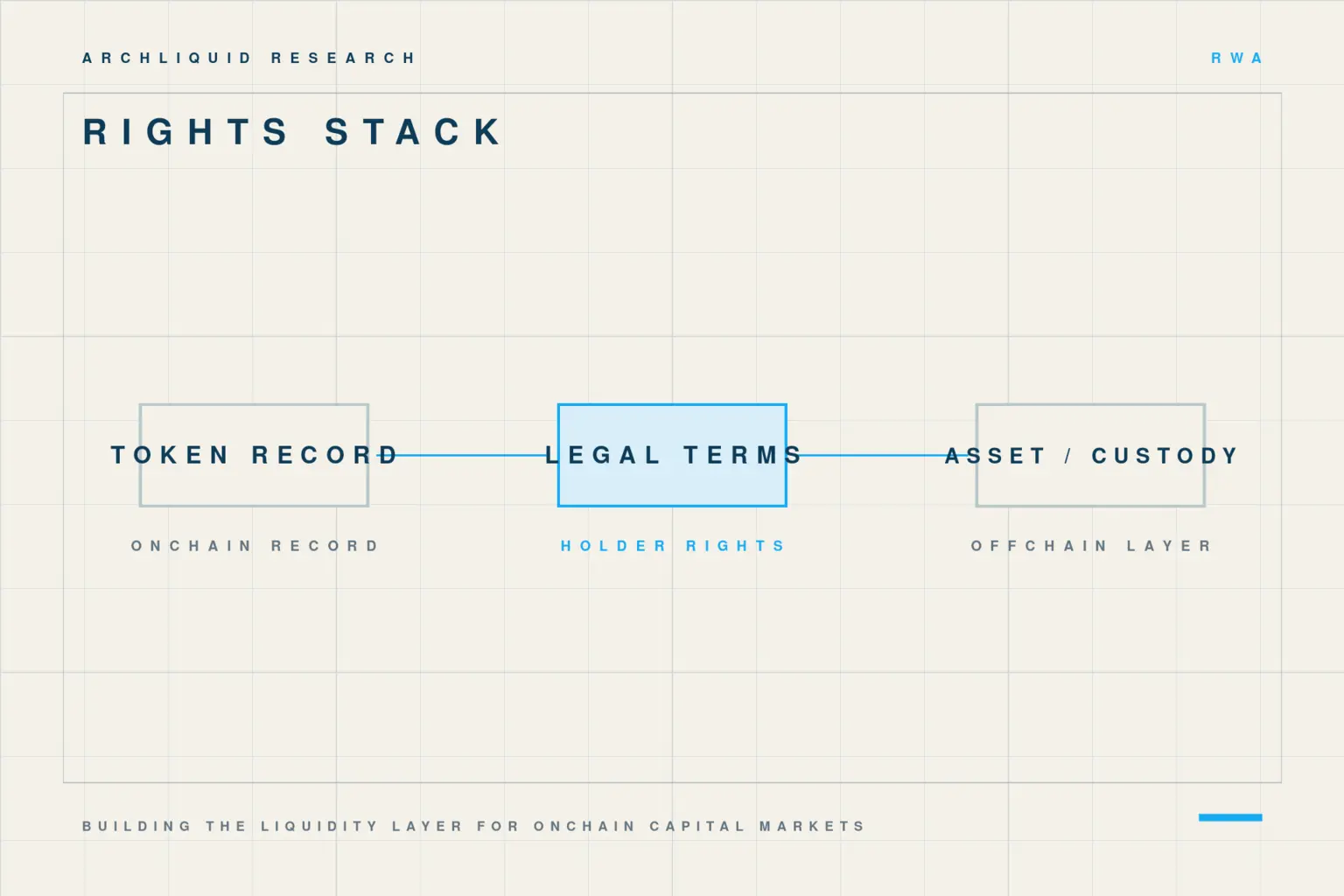
A useful RWA review follows the claim from the holder through the token contract, issuer records and custodian to the offchain asset. A break at any layer can change what the holder can enforce.
- Onchain layer
- Token balance
- Legal layer
- Terms and holder rights
- Asset layer
- Custody or issuer asset
- Exit layer
- Transfer or redemption
Shows control of an address-level record.
Defines the obligation attached to that record.
May sit outside the blockchain.
Eligibility and operational routes determine realizable value.
Source: Statement on tokenized securities (U.S. Securities and Exchange Commission).
A precise definition of tokenization
Real-world asset tokenization is the process of representing a claim on a physical or financial asset as a digital token on a programmable ledger. The underlying can be a security, a fund interest, a bond, real estate, a commodity claim or another enforceable right. The token becomes the ledger object that software can transfer and inspect, but the legal arrangement outside the ledger determines what that object means.
That distinction matters. A token may be issued by the asset's issuer, by a regulated intermediary holding the asset, or by an unaffiliated third party creating a separate instrument linked to the asset. The SEC staff's 2026 taxonomy describes both issuer-sponsored and third-party models. Two tokens can track the same stock price while giving holders very different ownership, redemption and insolvency rights.
What becomes programmable
Once a valid claim is represented on a programmable network, transfer rules can interact with settlement, collateral and reporting logic. A transaction can require both the asset and payment to move together. A corporate action can update a multiplier. A lending protocol can read collateral and enforce a health threshold. These are workflow improvements, not changes to the nature of the asset itself.
The BIS describes tokenization as a way to integrate messaging, reconciliation and settlement on programmable platforms. That is the central operational opportunity: fewer disconnected records and fewer manual handoffs. The strongest design still preserves the legal, monetary and risk controls that make a capital market trustworthy.
What tokenization does not solve automatically
Tokenization does not guarantee that reserves exist, that a custodian is solvent, that an oracle is fresh, or that a secondary market has enough depth. It also does not make a security stop being a security. Commissioner Hester Peirce summarized the point directly in 2025: changing the format does not change the substance of the instrument or remove the applicable legal requirements.
The technical record can be exact while the economic promise is weak. A flawless ERC-20 contract may represent an unsecured obligation. A public transfer history may coexist with opaque custody. Due diligence therefore has to cross the boundary between code and legal documentation rather than treating either one as complete evidence.
- Rights: ownership, beneficial interest, derivative exposure or a contractual payment claim
- Backing: identity, segregation and verification of the underlying assets
- Lifecycle: issuance, redemption, distributions, splits, mergers and termination
- Market structure: eligible users, venues, hours, halts, settlement and liquidity
Why public networks are useful
A public network can provide a shared state that wallets, applications, indexers and auditors read without asking one platform for permission. Contract addresses and transactions can be independently checked. Composability also lets one token interact with settlement, liquidity and collateral systems, subject to each system's risk controls.
Public visibility is not the same as complete transparency. The chain shows what the contracts record. It may not show offchain custody, the quality of an issuer's controls or the enforceability of a redemption promise. Reliable RWA systems make those boundaries explicit and publish the evidence available on both sides.
A practical evaluation framework
Start with the legal claim, then map every dependency needed for that claim to retain value. Identify the issuer, custodian, transfer agent, settlement asset, oracle, bridge and smart contracts. For each dependency, ask what happens during insolvency, market closure, data interruption or contract failure. A token is only as robust as the complete path from legal entitlement to onchain execution.
Finally, separate facts from ambitions. A testnet deployment proves that code can execute in a simulated economic environment. Source verification helps reviewers connect code to bytecode. Neither proves production liquidity, regulatory status or financial safety. Good infrastructure communicates exactly which layer has been verified and which assumptions remain.
Sources and further reading
Sources were accessed for this publication on August 4, 2026. Product terms, networks and deployments can change; check the linked primary source before acting.
- 01Statement on Tokenized SecuritiesU.S. Securities and Exchange Commission Staff
- 02Enchanting, but Not Magical: A Statement on the Tokenization of SecuritiesU.S. Securities and Exchange Commission
- 03The next-generation monetary and financial systemBank for International Settlements
- 04DTC authorized to offer tokenization serviceDTCC
Related reading
The Tokenized Capital Markets Risk Checklist: Rights, Custody, Liquidity and Oracles
The word tokenized describes a technical form. A sound review asks what the token represents, who stands behind it and how it behaves under stress.
Tokenized ETFs vs Tokenized Stocks: Exposure, Rights, Pricing and Liquidity
A token linked to one company and a token linked to a portfolio can share an ERC-20 interface while carrying very different valuation and lifecycle dependencies.
Private-Company Stock Tokens: Exposure, Valuation and Liquidity Limitations
A private-company name can make a token feel familiar while the underlying reference remains unlisted, infrequently priced and inaccessible to the holder.