Stock Split Math for Tokenized Stocks: Units, Prices and Historical Charts
A split changes units, not the holder's economic value at the split instant. Token systems must update balances and price series without manufacturing a return.
Key takeaways
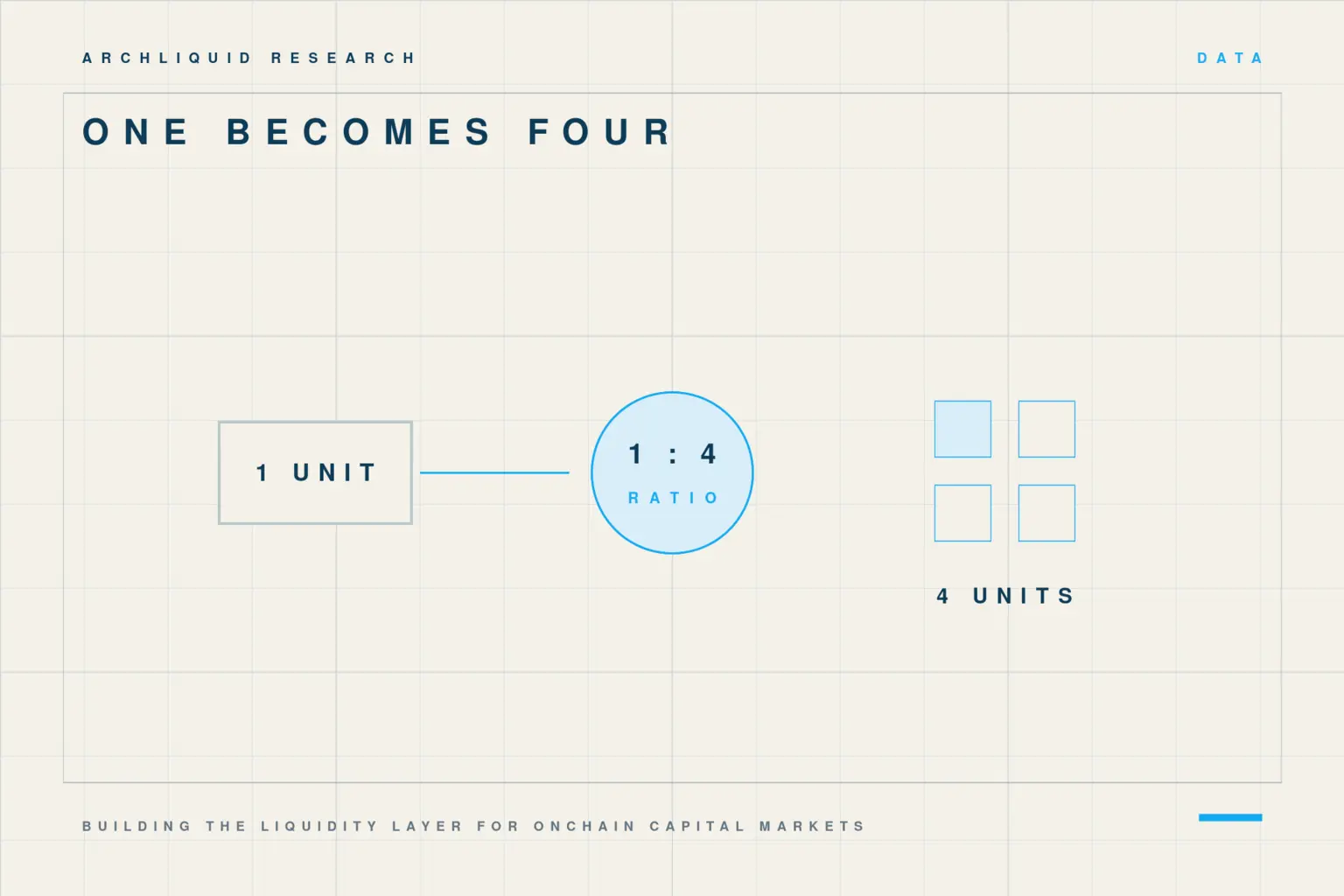
- In a four-for-one split, unit count multiplies by four while per-unit price divides by four at the split instant.
- Robinhood's API documentation includes an AAPL example with oldRate 1, newRate 4 and process date 2026-06-15.
- Ingestion must be idempotent and historical charts need an explicit raw-versus-adjusted policy.
Ten pre-split units become forty post-split units
Using the 1-to-4 ratio in Robinhood's documented AAPL event, a hypothetical 10-unit balance at $200 per unit becomes 40 units at $50 per unit. Notional value remains $2,000 before market movement.
- Before
- 10 × $200 = $2,000
- Split ratio
- 1 → 4
- After units
- 10 × 4 = 40
- After unit price
- $200 ÷ 4 = $50
Hypothetical balance and price.
Ratio from Robinhood's documented AAPL corporate-action example.
Unit count increases by the split factor.
Price normalization preserves notional value at the event instant.
The 10-unit balance and $200 price are illustrative. The event ratio and process date come from Robinhood's API documentation.
Source: Stock Token APIs (Robinhood Chain Documentation).
What a stock split changes
A stock split changes the number of units that represent the same proportional economic position. In a four-for-one event, each old unit becomes four new units. Ignoring any market movement and rounding, the unit price divides by four at the same moment, so total notional value is unchanged.
Tokenized systems have more than one place where units appear: wallet balances, issuer ledgers, exchange lots, oracle reports, charts and lending positions. A correct corporate-action process keeps those surfaces consistent or clearly marks the transition while settlement catches up.
Read the ratio in the correct direction
Robinhood's Stock Token API documentation includes a sample AAPL stock-split record with oldRate 1 and newRate 4. That represents a one-to-four conversion. A processor should not infer direction from the phrase stock split because reverse splits invert the effect.
Store the source fields exactly as received and compute a normalized factor through a tested function. The record also includes a process date and token address. Those fields bind the action to a particular timeline and instrument instead of every asset sharing the same symbol.
Separate balances from price history
Balance conversion and chart adjustment solve different problems. The holder's post-action units must support settlement. A historical chart may divide pre-split prices and multiply pre-split volume so the series remains visually comparable, but raw observations should remain available for audit and reconciliation.
Without adjustment, a four-for-one split can look like a seventy-five percent crash. Without preserving raw data, reviewers cannot reconstruct what the venue or API reported at the time. Store raw points, action records and derived adjusted points as separate objects.
Make action processing idempotent
Corporate-action ingestion jobs are retried. If a four-for-one event is applied twice, a 10-unit balance can incorrectly become 160. Use a stable upstream action identifier or a compound key of instrument, action type and process date, then record completion in the same durable transaction as the normalized output.
Late or corrected events need versioning rather than silent overwrite. Recalculate affected derived views, preserve the prior record and alert dependent risk systems. A collateral engine may need to pause an asset until balances and price feeds are proven to use the same basis.
Test fractional amounts and rounding
Token contracts use integer base units, while financial interfaces show decimals. Split factors can create fractional entitlements that do not divide cleanly at the displayed precision. Terms should define whether fractions are retained, rounded or settled in cash, and the implementation must match that rule.
Tests should cover forward and reverse splits, zero or malformed rates, duplicate actions, timestamps near day boundaries and wallets with the smallest possible balance. The invariant is not merely that totals look close; it is that the documented conversion and rounding policy is applied exactly once to every affected position.
Sources and further reading
Sources were accessed for this publication on August 4, 2026. Product terms, networks and deployments can change; check the linked primary source before acting.
Related reading
Tokenized Stock Dividends and Corporate Actions: What Applications Must Track
A price feed does not tell a holder whether a dividend is owed. Distribution rights, record dates and payment rails come from the instrument's terms and lifecycle data.
Real-World Asset Tokenization: What It Is and What It Does Not Change
Tokenization can make an asset programmable. It cannot, by itself, create ownership rights, remove counterparties, or make an illiquid market liquid.
What Are Tokenized Stocks? Ownership, Derivatives and Counterparty Risk
The phrase tokenized stock covers several legal structures. Price exposure, shareholder ownership and redemption rights are not interchangeable.