What Are Tokenized Stocks? Ownership, Derivatives and Counterparty Risk
The phrase tokenized stock covers several legal structures. Price exposure, shareholder ownership and redemption rights are not interchangeable.
Key takeaways
- Some tokenized securities are issuer-sponsored, while others are third-party instruments linked to a security.
- Price exposure does not necessarily include voting, transfer, redemption or direct shareholder rights.
- Counterparty and custody analysis is as important as smart-contract analysis.
Three products can track the same company and grant different rights
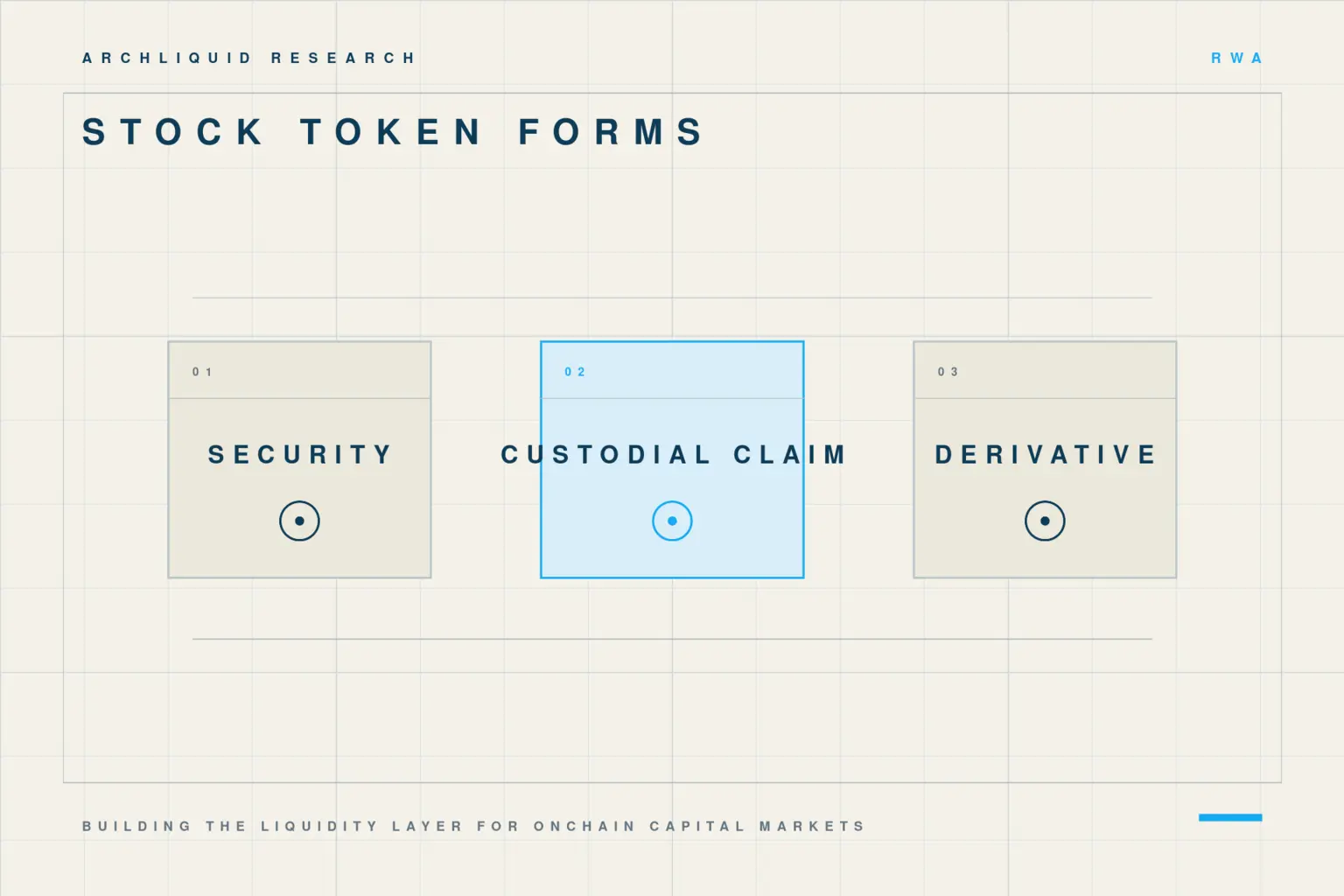
An issuer-sponsored security, an intermediated beneficial interest and a derivative price exposure may all be described as stock tokens. The contract name does not make their legal rights equivalent.
- Issuer-sponsored
- Issuer security
- Custodial representation
- Intermediated claim
- Derivative
- Economic exposure
- Review first
- Terms, issuer, redemption
Tokenization is part of the issuer's shareholder record structure.
Rights depend on custody, segregation and governing terms.
May track price without conferring ownership of the referenced share.
Ticker and onchain transferability come later.
Source: About Stock Tokens (Robinhood).
One label, several structures
A tokenized stock is a blockchain-recorded instrument connected economically or legally to a publicly traded share. That broad description hides the most important detail: who created the instrument and what the holder owns. The token can be the issuer's own security in digital form, a tokenized entitlement held through an intermediary, or a separate third-party security or derivative tied to an underlying stock.
The SEC staff's tokenized-securities statement emphasizes that these models provide different rights. An issuer-sponsored token may be part of the issuer's official ownership system. A third-party token may instead represent a claim against a custodian or distributor. In both cases, the blockchain format is only one part of the legal and operational arrangement.
Stock ownership versus stock-linked exposure
Direct share ownership commonly brings a defined relationship with the issuer and market infrastructure. A stock-linked token may provide economic exposure without making the holder a registered or beneficial shareholder. Voting rights, dividend treatment, transferability and access to issuer communications can differ. The correct answer comes from the product documentation, not the token symbol.
Robinhood Europe's Classic Stock Tokens provide a concrete example. Robinhood describes them as derivative contracts that follow the prices of stocks and ETFs rather than purchases of the actual shares. The support documentation explains that the instruments do not grant rights in the underlying securities and carry counterparty risk to Robinhood Europe. That disclosure should not be generalized to every tokenized-security model, but it shows why legal structure must be checked product by product.
Backing, custody and redemption
A backed product needs an operational chain connecting tokens to underlying assets. Investors should know who holds the shares, whether holdings are segregated, how frequently backing is reconciled, and who can mint or burn tokens. Redemption terms are equally important: can a holder receive cash, the underlying security, or only trade with the issuer on a designated venue? Restrictions can change the token's market behavior.
Counterparty risk remains even when token transfers are non-custodial. If a token represents an obligation of an issuer or intermediary, that entity's insolvency can impair the claim. A wallet can retain perfect control of a token whose offchain promise has failed. Self-custody protects keys; it does not remove issuer, custodian or legal-enforcement risk.
Dividends and corporate actions
Stocks change over time. Splits, reverse splits, mergers, name changes, delistings and dividends all require a tokenized instrument to preserve the intended exposure. Some systems alter token balances, some alter a shares-per-token multiplier, and some make separate cash payments. The documentation should state how record dates, withholding, rounding and ineligible accounts are handled.
Corporate-action handling also creates timing risk. A token market that remains open while the reference market is halted can trade on stale assumptions. Well-designed systems publish pending actions, expose halt status and give integrators a deterministic way to update pricing and accounting before enabling new risk.
Questions to ask before using a stock token
Read the legal description first. Identify the issuer, jurisdiction, investor eligibility rules and exact instrument type. Then verify the canonical contract address from the issuer's official registry. A familiar ticker and logo are not evidence because anyone can deploy an ERC-20 with similar metadata.
Next, trace the market infrastructure: where prices originate, where liquidity sits, what settles trades, how assets can be redeemed and what happens during a halt. Finally, inspect smart-contract permissions and verified source. This layered review does not eliminate risk, but it prevents the most common mistake: assuming that an onchain token and a conventional share are automatically the same asset.
- What precise legal instrument does the token represent?
- Who holds the underlying asset and who bears insolvency risk?
- Which rights, distributions and corporate actions reach token holders?
- Where can the token move, trade or redeem, and under what restrictions?
Sources and further reading
Sources were accessed for this publication on August 4, 2026. Product terms, networks and deployments can change; check the linked primary source before acting.
Related reading
How Robinhood Stock Tokens Handle Prices, Multipliers and Corporate Actions
Tokenized equities need more than a price feed. Splits, dividends, halts and shares-per-token multipliers must stay synchronized across every application.
Real-World Asset Tokenization: What It Is and What It Does Not Change
Tokenization can make an asset programmable. It cannot, by itself, create ownership rights, remove counterparties, or make an illiquid market liquid.
Robinhood Chain Explained: Architecture for Onchain Capital Markets
Robinhood Chain combines Ethereum-compatible execution with dedicated market infrastructure for tokenized assets. Here is what the architecture actually provides.