Testing RWA Protocols on Robinhood Chain Testnet: Evidence Before Mainnet
A green deployment transaction is the start of testnet validation, not the end. Release evidence must cover the complete user lifecycle.
Key takeaways
- Test the exact chain, deployed bytecode and dependencies that users will interact with.
- A release needs negative-path and full-lifecycle transactions, not only unit tests and deployment receipts.
- Unsupported or undocumented third-party contracts should remain clearly experimental and transaction-gated.
A test passes only when the complete lifecycle is mined
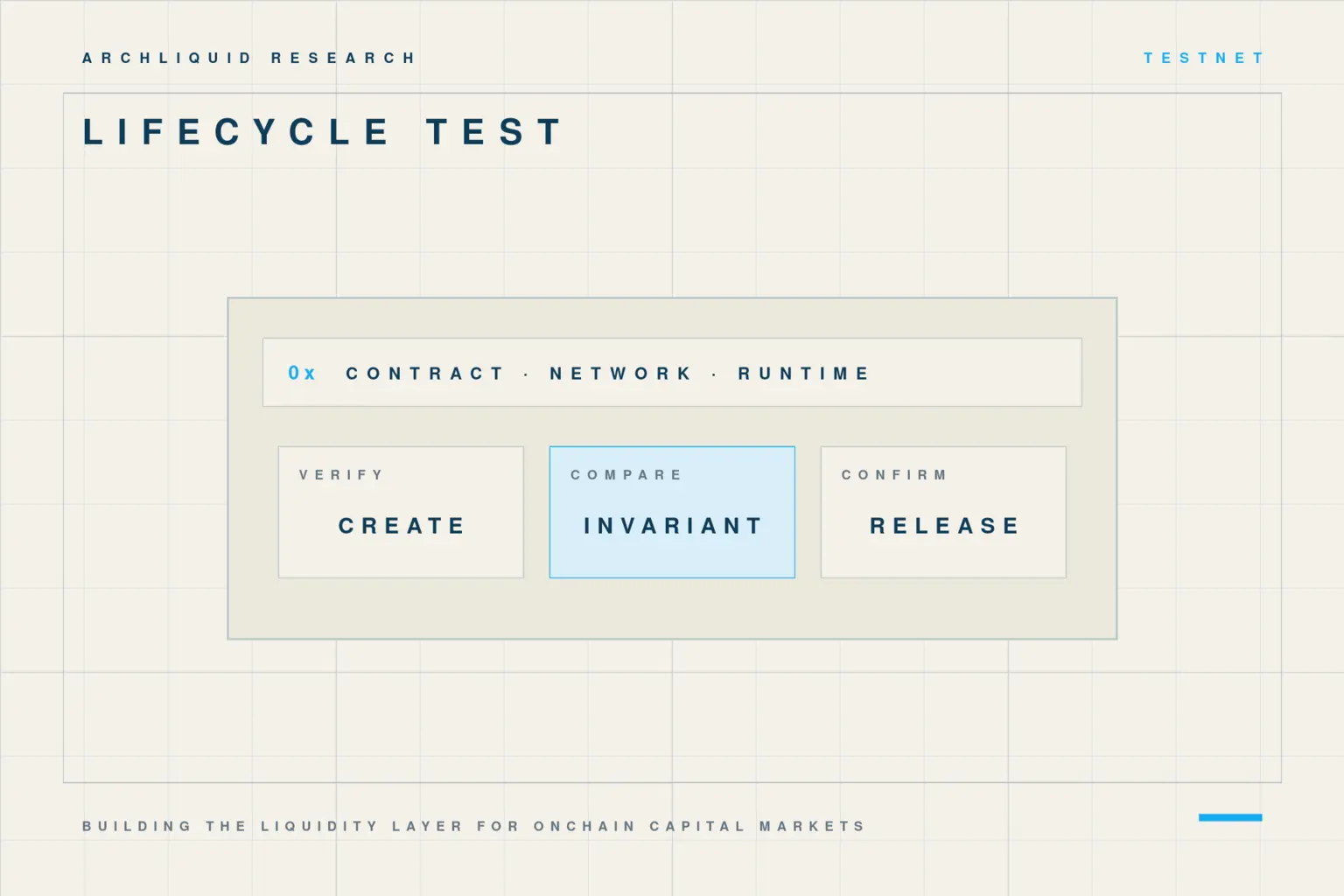
A useful testnet run creates a position, records the receipt, exercises allowed actions, proves forbidden actions revert and completes the eventual release. A successful deployment alone does not cover that path.
- Create
- Mined receipt
- Use
- Allowed action succeeds
- Attack
- Forbidden action reverts
- Release
- Final owner restored
Record transaction, block, event and created identifier.
For example, fee collection without principal withdrawal.
Test wrong owner, early unlock and wrong manager.
Confirm custody and event trail after maturity.
This is a test design example, not evidence that an unspecified deployment has completed every step.
What a testnet can prove
A public testnet shows whether contracts, wallets, RPC endpoints, indexers and interfaces work together under real transaction ordering. It can expose wrong chain IDs, missing code at assumed addresses, gas-estimation failures, stale explorer data and signature flows that a local test does not reproduce. It also gives users a place to learn without putting mainnet assets at risk.
A testnet cannot prove economic safety by itself. Mock tokens have no market value, oracle conditions may be simplified and usage is less adversarial than mainnet. Passing testnet evidence should therefore be described as integration evidence, not as an audit or guarantee.
Bind tests to the real network
Robinhood documents separate chain IDs and RPC endpoints for mainnet and testnet. Every script should assert the expected chain ID before broadcasting. A manifest should record each deployed address, transaction hash, block, constructor arguments, compiler settings and runtime code hash. The web interface should read that manifest rather than copy addresses into unrelated files.
Dependency addresses require the same treatment. A contract documented for mainnet may have no code on testnet, while an experimental testnet deployment may not match mainnet bytecode. Before enabling a module, inspect live code and immutable wiring for the exact environment instead of assuming that a familiar address or function signature establishes compatibility.
Layer the evidence
Unit tests establish contract invariants quickly. Fuzz and invariant tests explore wider input and state spaces. Fork tests prove compatibility with observed external contracts at a pinned block. Finally, mined testnet transactions prove that the deployed stack and public RPC can execute the intended lifecycle.
For a liquidity locker, that lifecycle includes approval, lock creation, rejected early withdrawal, permitted fee collection, maturity and final withdrawal. For vesting, it includes funding, pre-cliff rejection, partial claim and final claim. For lending, it includes supply, collateral enablement, borrow, repayment, interest accrual and liquidation boundaries.
Test failure and recovery paths
RWA integrations depend on offchain market state and external data. Tests should cover stale prices, halted underliers, pending corporate-action multipliers, paused tokens and unavailable APIs. Chain-facing tests should cover rejected callbacks, fake LP assets, unsupported hooks, transferred NFTs, insufficient gas and network changes during a flow.
The interface should recover without guessing. If an indexer is unavailable, it can ask for a known position ID or display a precise unavailable state; it should not fabricate an empty portfolio. If a transaction is disabled because deployment evidence is missing, the reason should be visible beside the control.
Turn evidence into a release gate
A release checklist should require passing tests, exact deployment metadata, live code, verified or reproducibly matched source, role ownership, emergency controls and representative mined transactions. Each item has an evidence link or machine-checkable value. An approval then refers to a concrete artifact rather than a general belief that the code is ready.
ArchLiquid applies that distinction to Robinhood Chain integrations: a module can be implemented and fork-tested while its public transaction path remains disabled. This is especially important for experimental testnet infrastructure whose provenance differs from an official mainnet deployment. Honest gating makes later support easier to defend and reproduce.
Sources and further reading
Sources were accessed for this publication on August 4, 2026. Product terms, networks and deployments can change; check the linked primary source before acting.
Related reading
Real-World Asset Tokenization: What It Is and What It Does Not Change
Tokenization can make an asset programmable. It cannot, by itself, create ownership rights, remove counterparties, or make an illiquid market liquid.
What Are Tokenized Stocks? Ownership, Derivatives and Counterparty Risk
The phrase tokenized stock covers several legal structures. Price exposure, shareholder ownership and redemption rights are not interchangeable.
Robinhood Chain Explained: Architecture for Onchain Capital Markets
Robinhood Chain combines Ethereum-compatible execution with dedicated market infrastructure for tokenized assets. Here is what the architecture actually provides.