Robinhood Chain Explained: Architecture for Onchain Capital Markets
Robinhood Chain combines Ethereum-compatible execution with dedicated market infrastructure for tokenized assets. Here is what the architecture actually provides.
Key takeaways
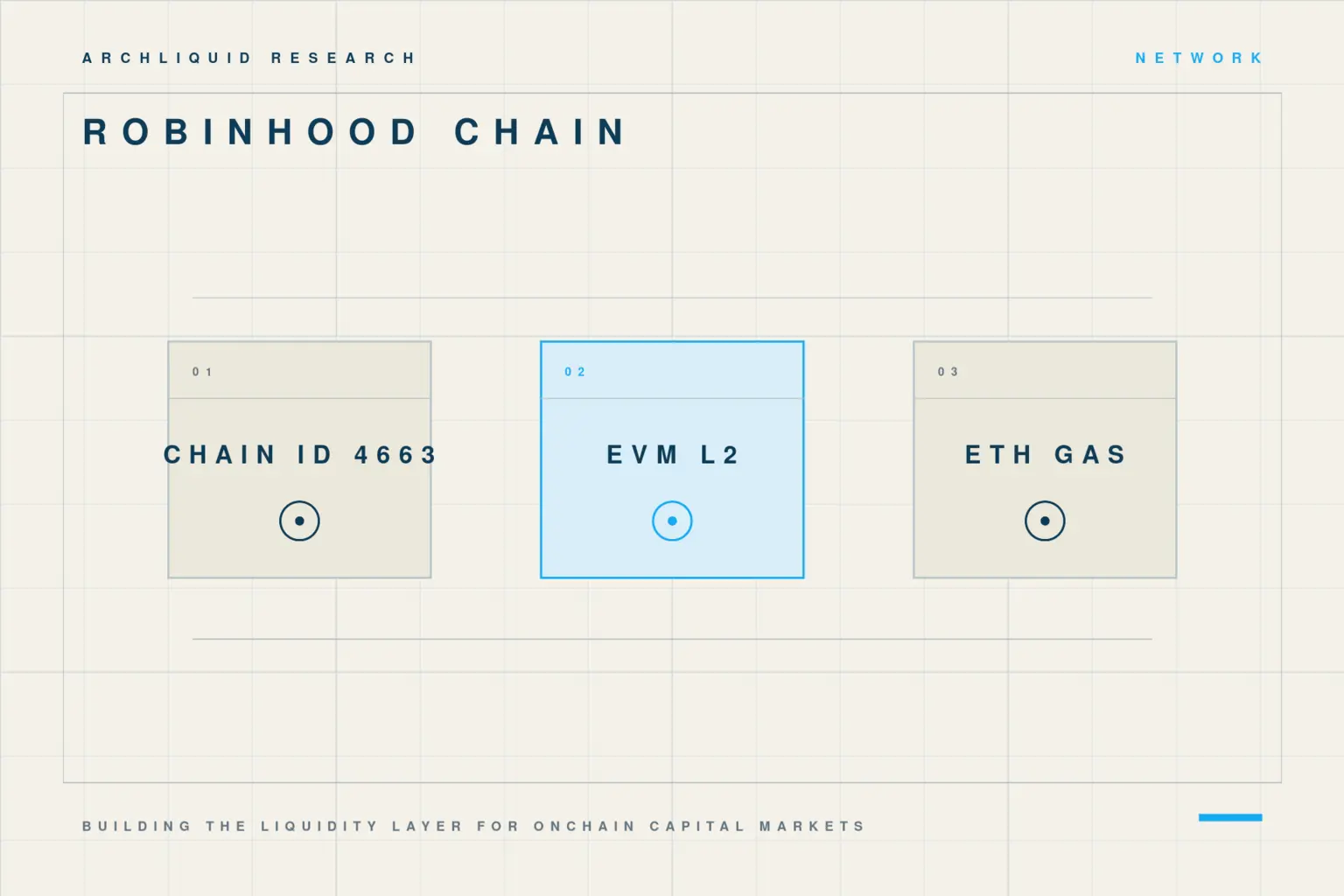
- Robinhood Chain is an EVM-compatible Arbitrum Layer-2 network using ETH for gas.
- Its public documentation positions the chain around tokenized equities, ETFs and other RWAs.
- Application teams still need to assess sequencer, governance, bridge, oracle and contract risks separately.
Robinhood Chain at a glance
The documented network uses Ethereum-compatible tooling, ETH for gas and distinct mainnet and testnet identities. Public RPC endpoints are intended for development and can be rate-limited.
- Mainnet chain ID
- 4663
- Testnet chain ID
- 46630
- Native currency
- ETH
- Execution model
- EVM-compatible L2
Explorer: explorer.chain.robinhood.com
Explorer: explorer.testnet.chain.robinhood.com
Used to pay transaction fees.
Applications use familiar Ethereum interfaces and wallets.
Source: Connecting to Robinhood Chain (Robinhood Chain Documentation).
What Robinhood Chain is
Robinhood Chain is a permissionless, Ethereum-compatible Layer-2 blockchain designed for onchain financial infrastructure. Its official documentation focuses on tokenized real-world assets such as equities, ETFs, private assets and other financial instruments. Mainnet uses chain ID 4663, while the separate testnet uses chain ID 46630.
Permissionless means independent developers can deploy contracts and users can interact through standard wallets and JSON-RPC tools. It does not mean every application, token or contract on the network is reviewed or endorsed by Robinhood. The chain documentation explicitly separates ecosystem visibility from endorsement and tells users to evaluate third-party protocols independently.
Arbitrum Layer-2 architecture
The network is built with Arbitrum's dedicated-chain technology and posts data to Ethereum. Execution occurs away from Ethereum mainnet, reducing the amount of work the base layer must process for each application transaction. ETH is the native gas token. Developers can use Solidity, Foundry, Hardhat, viem, Wagmi and other standard EVM tooling.
Layer 2 does not mean risk-free or identical to Ethereum mainnet. Users depend on the rollup's sequencing, upgrade governance, data availability, bridge and dispute system. A serious integration evaluates those boundaries instead of treating EVM compatibility as a complete security model.
Ordering and market behavior
Robinhood Chain documents a first-come, first-served sequencing model in which arrival order determines transaction ordering rather than a user simply paying more to jump ahead. Predictable ordering can matter for market applications because it influences how participants reason about execution priority and extraction around time-sensitive transactions.
Ordering policy is only one part of execution quality. Applications still need slippage controls, deadlines, minimum outputs and protection against stale prices. An AMM trade can be ordered predictably and still execute at a poor price if the user signs weak constraints.
Governance and dispute resolution
The published governance model uses an eight-seat Security Council. Routine actions require six approvals and a seven-day timelock, while emergency actions require seven approvals and can bypass the delay. The documentation names Robinhood, BitGo, Chainlink Labs, Fireblocks, Offchain Labs, Paxos and Talos as participants across those seats.
Robinhood Chain uses Arbitrum BoLD for dispute resolution with a permissioned validator set. Those are material facts for application risk models: the network is public and EVM-compatible, but its operational and governance assumptions differ from Ethereum Layer 1. Teams should monitor upgrades, council actions, validator status and bridge conditions.
Why the chain is relevant to RWA builders
The network combines canonical stock-token contracts, price and corporate-action APIs, Chainlink data infrastructure, stablecoin settlement assets, Uniswap liquidity and standard EVM composability. That creates a practical surface for applications that need to identify tokenized assets, read prices, manage market state and connect to liquidity.
The opportunity is to build controls around that shared infrastructure. Canonical address checks reduce counterfeit risk. Corporate-action multipliers keep quantities aligned. Oracle freshness and halt checks protect lending. Source verification connects public code to deployed bytecode. Robinhood Chain supplies rails; each protocol remains responsible for the safety and truthfulness of its own integration.
Sources and further reading
Sources were accessed for this publication on August 4, 2026. Product terms, networks and deployments can change; check the linked primary source before acting.
Related reading
Bridging RWAs to Robinhood Chain: Routes, Finality and Risk
A bridge does more than move a balance between interfaces. It changes the custody, message-finality and contract assumptions around that balance.
Robinhood Chain Network Configuration: Mainnet, Testnet, RPC and Explorer
A wallet network is more than an RPC URL. Chain ID, explorer, native currency and endpoint reliability must agree before a transaction is safe to request.
Robinhood Chain Governance: Council Thresholds, Timelocks and Validators
Chain governance defines who can change the system and how quickly. The published thresholds are useful only when their different powers are kept distinct.