Smart-Contract Vesting for RWA and Tokenized-Equity Projects
Vesting turns an allocation promise into a release curve the chain can enforce and the market can inspect.
Key takeaways
- A vesting contract should custody funded tokens and compute release from immutable schedule inputs.
- Cliff, start, end, beneficiary and revocation policy must be visible before funding.
- Vesting controls token release, not the legal quality or market value of the token.
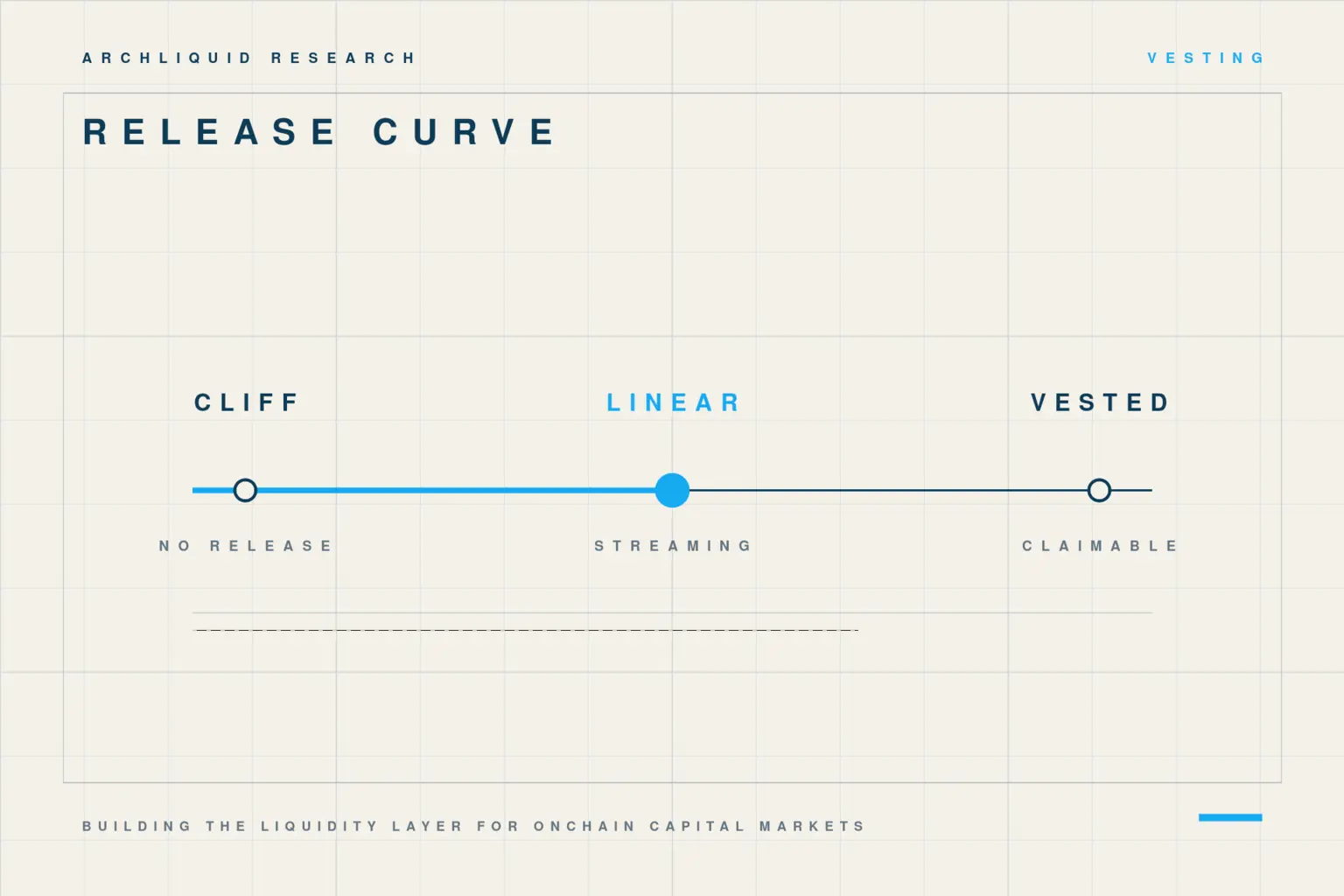
A 12-month cliff followed by 24 months of linear release
For a hypothetical 3.6 million-token allocation, nothing releases during the first year. After the cliff, 150,000 tokens become claimable for each completed month across the following 24 months.
- Allocation
- 3,600,000
- Cliff
- 12 months
- Linear period
- 24 months
- Month 18 claimable
- 900,000
Hypothetical token allocation.
Claimable amount remains zero before the cliff.
3,600,000 ÷ 24 = 150,000 per completed month.
Six months of linear release after the cliff.
This calculation is illustrative and does not describe an ArchLiquid or Robinhood token allocation.
Why vesting belongs onchain
RWA and tokenized-market projects often allocate tokens to teams, investors, advisors or treasuries. A written lockup can be difficult for outside users to monitor. An onchain vesting contract holds the allocation and releases only the amount permitted by its schedule, producing a public record of funding and claims.
This can reduce discretion around distribution timing. It does not decide whether the allocation is fair or legally compliant. The value of the mechanism is that the stated schedule and funded amount are inspectable and executable without relying on a project operator to calculate each release.
Cliffs and linear release
A cliff prevents any release before a specified time. After the cliff, a schedule may unlock an initial amount or begin a linear stream from start to end. The contract calculates vested tokens from elapsed time and subtracts amounts already claimed. Exact boundary tests are essential because off-by-one errors can change eligibility at the cliff or final second.
Dates in an interface should resolve to explicit UTC timestamps before signature. A displayed calendar date without timezone context can lead users to approve a different moment than intended. The transaction preview should show cliff, start, end, total amount and beneficiary in both human-readable and verifiable forms.
Funding and beneficiary safety
A schedule is meaningful only if it is funded. The creation flow should transfer the promised tokens into custody atomically or make underfunding unmistakable. Fee-on-transfer and rebasing tokens can break simple accounting assumptions, so a vesting system should define which token behaviors it supports.
Claims must go to the recorded beneficiary or an explicitly approved destination. Ownership transfers, if supported, need clear events and authorization. Batch creation should ensure that one malformed row cannot silently shift amounts between beneficiaries.
Revocable versus immutable schedules
A revocable schedule lets an authorized party recover unvested tokens under defined conditions. An immutable schedule removes that discretion after creation. Neither model is universally correct, but the choice changes counterparty risk and should be displayed prominently before a beneficiary relies on the allocation.
Admin powers should be narrow and auditable. A contract owner that can rewrite beneficiaries, shorten the schedule or withdraw funded tokens has not created a strong vesting commitment. Extensions may be safer than acceleration because they cannot release principal earlier, but even extensions can affect beneficiary expectations and need an explicit policy.
Vesting in an RWA market context
For tokenized-asset projects, vesting may apply to a protocol token rather than the underlying stock token. The interface should never blur those categories. A vested project allocation is not the same as a regulated shareholder lockup, and it does not create rights in the referenced real-world asset.
The strongest evidence package combines verified vesting bytecode, canonical token identity, funded balance, schedule events and current claimable amount. Users can then distinguish an enforceable release rule from marketing language while continuing to evaluate issuer, liquidity and legal risk separately.
Sources and further reading
Sources were accessed for this publication on August 4, 2026. Product terms, networks and deployments can change; check the linked primary source before acting.
Related reading
Real-World Asset Tokenization: What It Is and What It Does Not Change
Tokenization can make an asset programmable. It cannot, by itself, create ownership rights, remove counterparties, or make an illiquid market liquid.
What Are Tokenized Stocks? Ownership, Derivatives and Counterparty Risk
The phrase tokenized stock covers several legal structures. Price exposure, shareholder ownership and redemption rights are not interchangeable.
Robinhood Chain Explained: Architecture for Onchain Capital Markets
Robinhood Chain combines Ethereum-compatible execution with dedicated market infrastructure for tokenized assets. Here is what the architecture actually provides.