RWA Collateral in Onchain Lending: LTV, Liquidation and Market-Hours Risk
An asset can have a recognizable price and still be weak collateral if the protocol cannot value or sell it when debt becomes unsafe.
Key takeaways
- Collateral quality combines enforceable rights, reliable valuation, liquidity and operational settlement-not price alone.
- Maximum LTV and liquidation threshold should leave room for volatility, execution costs and oracle delay.
- Market closures, halts and redemption restrictions require explicit controls before tokenized equities support borrowing.
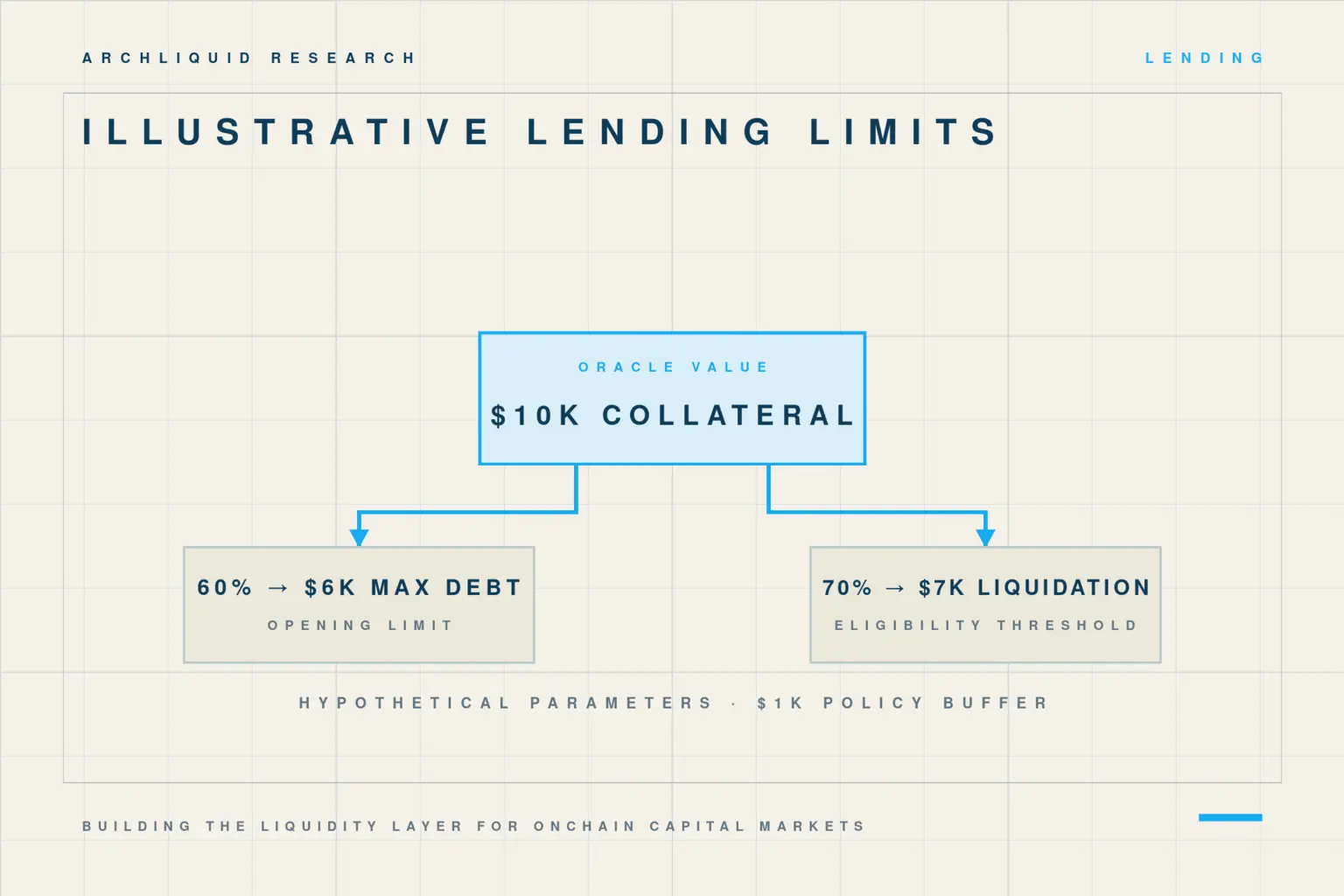
A $10,000 collateral position with a 60% maximum LTV
With a hypothetical $10,000 collateral value, 60% maximum LTV permits $6,000 of debt. An independently chosen 70% liquidation threshold begins liquidation at $7,000, leaving a $1,000 policy buffer.
- Collateral value
- $10,000
- Maximum LTV
- 60% → $6,000
- Liquidation threshold
- 70% → $7,000
- Policy buffer
- $1,000
Hypothetical oracle value before liquidity haircut.
Borrowing limit for opening or expanding debt.
Illustrative debt value at which liquidation becomes eligible.
Difference between maximum initial borrowing and liquidation point.
All values and parameters are illustrative. They are not live ArchLiquid market settings or investment guidance.
Collateral must be realizable under stress
A lending protocol accepts collateral because it expects to recover debt by selling or otherwise realizing the asset if the borrower becomes unsafe. Tokenized real-world assets add rights, custody and market dependencies to that process. A contract balance is useful only if the token can be transferred and converted into dependable settlement value.
Start with the legal instrument. A holder may own an issuer security, an intermediated claim or a derivative exposure. Those structures can have different redemption, freeze and insolvency behavior. Smart-contract composability cannot turn an uncertain offchain claim into equivalent collateral.
LTV is a policy, not a property of the token
Loan-to-value divides debt by collateral value. A maximum LTV limits how much debt can be created, while a higher liquidation threshold defines when the position can be liquidated. The gap gives the borrower time and gives the protocol room for value movement before debt exceeds expected recovery.
Parameter selection should consider volatility, price update delay, market depth, settlement fees and concentration. A highly liquid public-market reference does not guarantee that its token wrapper has equivalent liquidity. The protocol must evaluate the market it can actually use during liquidation.
Price policy includes status and source
Tokenized equities can reference markets with defined sessions and trading halts. Oracle policy should combine verified report authenticity with timestamp, market status, decimals and multiplier handling. A recent report can explicitly describe a halted market; a cryptographically valid report can still be inappropriate for risk-increasing actions.
Fallbacks should be designed before failure. Reusing the last price indefinitely hides uncertainty, while immediately marking collateral at zero can trigger destructive liquidations. Protocols can keep repayment and added collateral available while restricting new debt during degraded data.
Liquidation depends on executable liquidity
A liquidation bonus attracts actors to repay debt in exchange for discounted collateral. It succeeds only if liquidators can value and exit the asset. Thin pools, bridge delays, transfer restrictions and closed reference markets can all make the apparent bonus insufficient.
Simulations should use size-aware price impact rather than last trade. They should also test clustered liquidations when many users hold the same collateral. An asset that can absorb one position may fail when a common price shock makes an entire market liquidatable.
Release gates for RWA lending markets
Before listing collateral, record canonical identity, product rights, oracle behavior, liquidity venues, bridge dependencies and administrative controls. Run lifecycle tests for supply, borrow, repay, withdrawal and liquidation, including halted and stale-data states. Parameter changes should use visible governance and monitoring.
Interfaces must distinguish test assets from real-value collateral. A mock ticker and a production product can share code paths while carrying completely different rights and liquidity. Clear status labels prevent successful contract interactions from being mistaken for a complete market launch.
Sources and further reading
Sources were accessed for this publication on August 4, 2026. Product terms, networks and deployments can change; check the linked primary source before acting.
Related reading
Health Factor for Tokenized Equity Loans: A Step-by-Step Calculation
Health factor compresses collateral and debt into one ratio. The formula is simple; choosing a trustworthy collateral value is the difficult part.
Real-World Asset Tokenization: What It Is and What It Does Not Change
Tokenization can make an asset programmable. It cannot, by itself, create ownership rights, remove counterparties, or make an illiquid market liquid.
What Are Tokenized Stocks? Ownership, Derivatives and Counterparty Risk
The phrase tokenized stock covers several legal structures. Price exposure, shareholder ownership and redemption rights are not interchangeable.