Health Factor for Tokenized Equity Loans: A Step-by-Step Calculation
Health factor compresses collateral and debt into one ratio. The formula is simple; choosing a trustworthy collateral value is the difficult part.
Key takeaways
- A common health-factor form is collateral value multiplied by liquidation threshold, divided by debt value.
- A value above one provides a buffer; one or below commonly indicates liquidation eligibility under that model.
- Oracle quality, market status and liquidation liquidity determine whether the displayed ratio is economically meaningful.
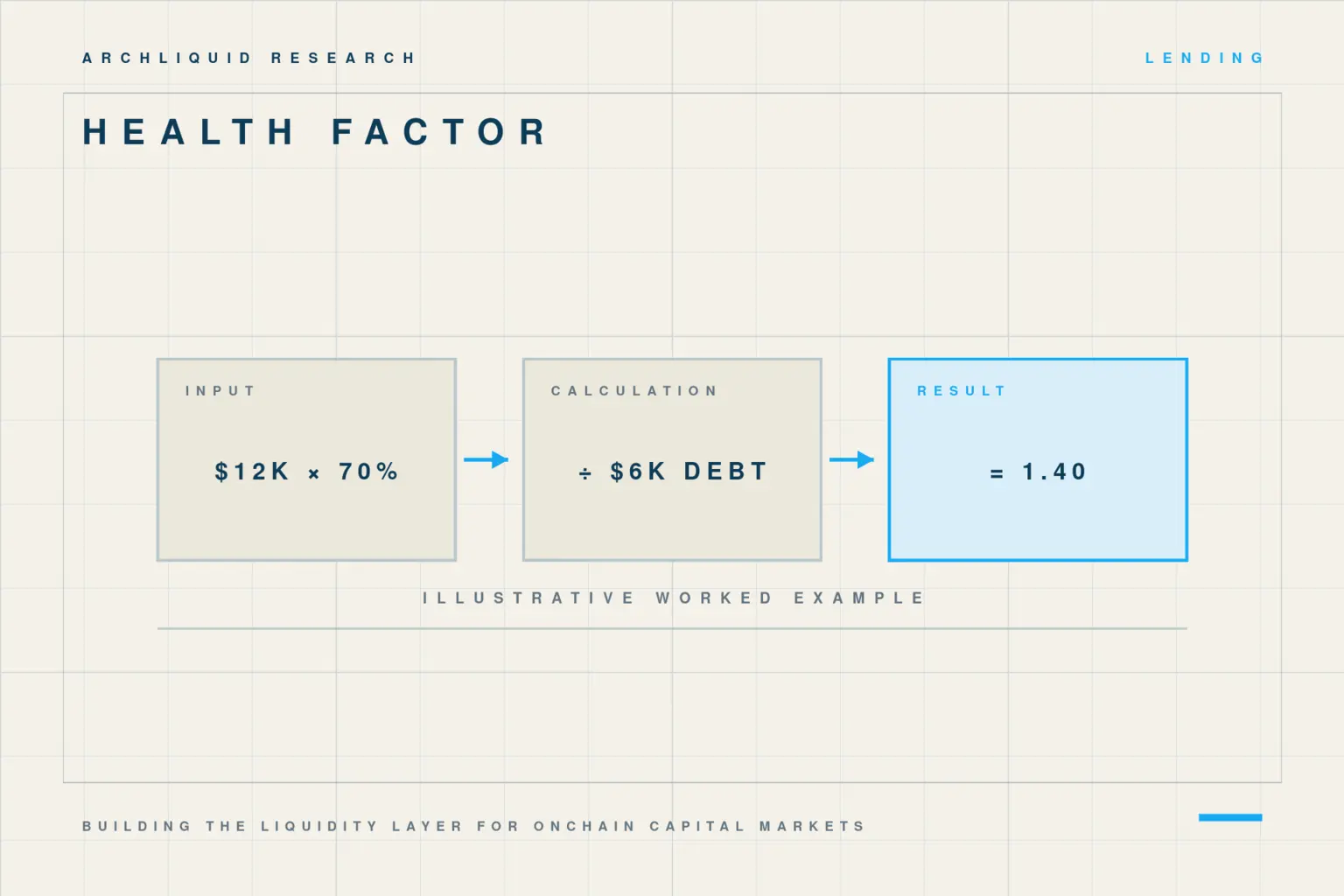
$12,000 collateral at a 70% threshold against $6,000 debt
The illustrative adjusted collateral is $8,400. Dividing by $6,000 debt gives a 1.40 health factor. A 20% collateral-price drop lowers it to 1.12 before fees or debt growth.
- Collateral
- $12,000 × 70%
- Debt
- $6,000
- Health factor
- $8,400 ÷ $6,000 = 1.40
- After 20% price fall
- 1.12
Adjusted collateral value: $8,400.
Hypothetical current debt value.
Above the example liquidation boundary of 1.00.
$9,600 × 70% ÷ $6,000.
Illustrative formula and parameters. Protocol implementations can differ; always read the market's actual contract and documentation.
What the ratio measures
A health factor compares threshold-adjusted collateral value with debt value. In a common form, the numerator is each collateral asset's value multiplied by its liquidation threshold, summed across the account. The denominator is total debt value. A larger number indicates more room before the modeled liquidation boundary.
The ratio is not a guarantee of safety. It is an output of price sources and governance parameters. If collateral cannot be sold near its reported value, the protocol can suffer a shortfall even when liquidation begins exactly where the formula says it should.
Calculate the adjusted collateral
Take the current quantity of each collateral asset and multiply it by the accepted oracle price. Then multiply that value by the asset's liquidation threshold. If an account holds different assets, calculate each contribution separately because thresholds can differ before adding them together.
Tokenized equities require careful unit handling. Contract decimals, token multipliers and underlying price units can differ. Store raw integers and explicit scale factors, and test a known example end to end. A decimal error can shift health factor by orders of magnitude while still producing a normal-looking number.
Debt changes even without a new borrow
Variable-rate debt grows as interest accrues. A health factor can therefore fall while the collateral price remains unchanged. If debt is denominated in a volatile settlement asset, its quote value can also rise independently. Interfaces should identify the valuation currency and update both sides from the same coherent state.
Pending transactions introduce another complication. Showing a simulated repayment before it is mined can overstate safety. The UI should label optimistic state clearly and reconcile to the receipt and new block before replacing the confirmed health factor.
Stress the inputs, not just the result
Useful risk views show the price at which health factor reaches one, the effect of debt growth and the result of defined price shocks. For a tokenized stock, stress scenarios should include a gap at market open, a halt, a split-processing delay and reduced onchain liquidity.
A single percentage drop is not enough. Collateral and debt may move together or in opposite directions, and liquidation execution can add price impact. Scenario outputs should state assumptions so users do not read them as forecasts.
Design the degraded-data state
When an oracle report is stale or the reference market is halted, the interface may be unable to produce a trustworthy live factor. Displaying the last value without context can be worse than showing unavailable. Preserve the last timestamp and explain which actions the protocol currently allows.
Contracts need deterministic policy for the same event. Risk-reducing actions can often continue while new borrowing stops. Recovery can require valid reports and bounded deviation. The displayed health factor is then part of a wider state machine, not an isolated dashboard metric.
Sources and further reading
Sources were accessed for this publication on August 4, 2026. Product terms, networks and deployments can change; check the linked primary source before acting.
Related reading
RWA Collateral in Onchain Lending: LTV, Liquidation and Market-Hours Risk
An asset can have a recognizable price and still be weak collateral if the protocol cannot value or sell it when debt becomes unsafe.
Real-World Asset Tokenization: What It Is and What It Does Not Change
Tokenization can make an asset programmable. It cannot, by itself, create ownership rights, remove counterparties, or make an illiquid market liquid.
What Are Tokenized Stocks? Ownership, Derivatives and Counterparty Risk
The phrase tokenized stock covers several legal structures. Price exposure, shareholder ownership and redemption rights are not interchangeable.