Oracles for Tokenized Equities: Price Freshness, Halts and Multipliers
A signed price is not automatically a safe price. Tokenized-equity protocols must know what was priced, when it was updated and whether the market was tradable.
Key takeaways
- Oracle consumers must validate timestamp, decimals, sign, asset identity and market state.
- Raw underlying prices and multiplier-adjusted token prices cannot be mixed without conversion.
- Halts and closed reference markets need explicit lending and liquidation policies.
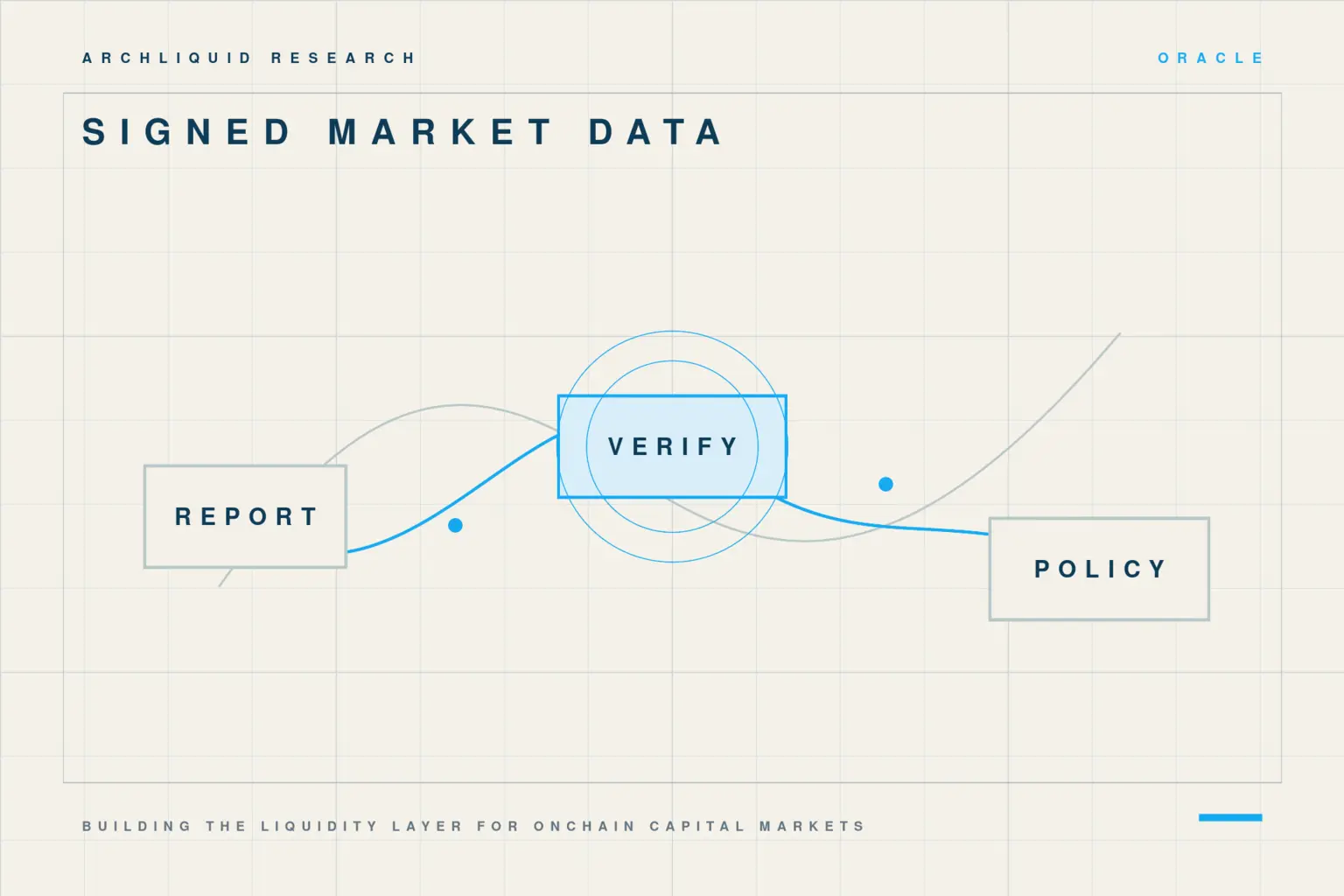
Pull a signed market report, verify it, then apply freshness policy
Chainlink Data Streams delivers signed offchain reports that a consumer verifies onchain. A lending market still needs its own rules for age, market status and deviation.
- Robinhood verifier
- 0xcE73…36E7
- Consumer checks
- Timestamp + status
VerifierProxy address documented for Robinhood Chain mainnet.
Verification alone does not decide whether a price is suitable collateral data.
Source: Data Streams on Robinhood Chain (Robinhood Chain Documentation).
What an equity oracle actually answers
An oracle reports a value under a particular methodology. For a tokenized equity, that value might be the underlying share's bid, a consolidated market price, or a token-level value adjusted by a shares-per-token multiplier. A protocol must know which quantity it is receiving before using it for collateral, liquidations or AMM controls.
Asset identity comes first. The feed, stock token and multiplier must refer to the same underlying and chain deployment. Symbol matching is not enough. A wrong but plausible feed can produce internally consistent calculations for the wrong asset.
Freshness and heartbeat controls
Every price has an observation time. Lending code should reject data older than its explicit maximum age and should not assume that a successful contract call means a recent market update. The threshold must reflect the feed methodology and the speed at which the collateral can move.
High-frequency applications may use pull-based signed reports. Robinhood Chain documents Chainlink Data Streams as an offchain delivery system with onchain verification when requested. That reduces unnecessary writes and can deliver rapid updates, but consumers still need to authenticate reports, check timestamps and handle service or verifier unavailability.
Decimals, signs and scaling
Oracle values and ERC-20 amounts often use different decimals. A correct formula explicitly scales both sides and rejects zero or negative values. Hard-coding an assumed eight-decimal oracle can overvalue or undervalue collateral when a feed uses a different format. The error may be large enough to make insolvent borrowing appear healthy.
Stock-token multipliers add another dimension. Robinhood's documentation distinguishes raw underlying prices from multiplier-adjusted onchain values. Integrators should choose one canonical calculation path, document it, and test forward split, reverse split and pending-multiplier transitions with exact integer arithmetic.
Trading halts and closed markets
A fresh timestamp is not the same as a freely tradable reference. An underlying can be halted, restricted to closing or outside its active session. Robinhood's price API exposes a trading-halt flag and its asset metadata includes trading capabilities. Risk engines should use those states rather than inferring availability from the last numerical price.
During a halt, a protocol can pause new borrowing, reduce collateral factors, stop liquidations based on stale values, or use a documented fallback. Each choice shifts risk between borrowers, lenders and the protocol. The policy should be visible before the halt occurs and tested against recovery when the market reopens.
A minimum oracle acceptance policy
A robust read validates the feed address, answer sign, update time, expected decimals, round completeness where applicable, multiplier state and market status. It also records which observation informed a consequential action. Monitoring should alert on delayed updates, sudden deviations and feed-configuration changes.
Oracles reduce information asymmetry between offchain markets and contracts; they do not eliminate it. A protocol remains exposed to methodology, liveness and basis risk. Conservative collateral parameters and clearly defined circuit breakers are part of oracle design, not optional operations work.
Sources and further reading
Sources were accessed for this publication on August 4, 2026. Product terms, networks and deployments can change; check the linked primary source before acting.
Related reading
Real-World Asset Tokenization: What It Is and What It Does Not Change
Tokenization can make an asset programmable. It cannot, by itself, create ownership rights, remove counterparties, or make an illiquid market liquid.
What Are Tokenized Stocks? Ownership, Derivatives and Counterparty Risk
The phrase tokenized stock covers several legal structures. Price exposure, shareholder ownership and redemption rights are not interchangeable.
Robinhood Chain Explained: Architecture for Onchain Capital Markets
Robinhood Chain combines Ethereum-compatible execution with dedicated market infrastructure for tokenized assets. Here is what the architecture actually provides.