Institutional Tokenization in Practice: What SEC, DTCC and BIS Records Show
Institutional tokenization is moving from prototypes toward controlled production, but scope, legal rights and settlement architecture remain specific to each initiative.
Key takeaways
- SEC staff describes tokenized securities as securities and distinguishes issuer-sponsored from third-party structures.
- DTC announced regulatory authorization for a controlled tokenization service covering defined DTC-custodied asset categories.
- BIS analysis emphasizes sound money, governance and institutional design rather than treating tokenization as a standalone replacement for financial structure.
Three records answer three different questions
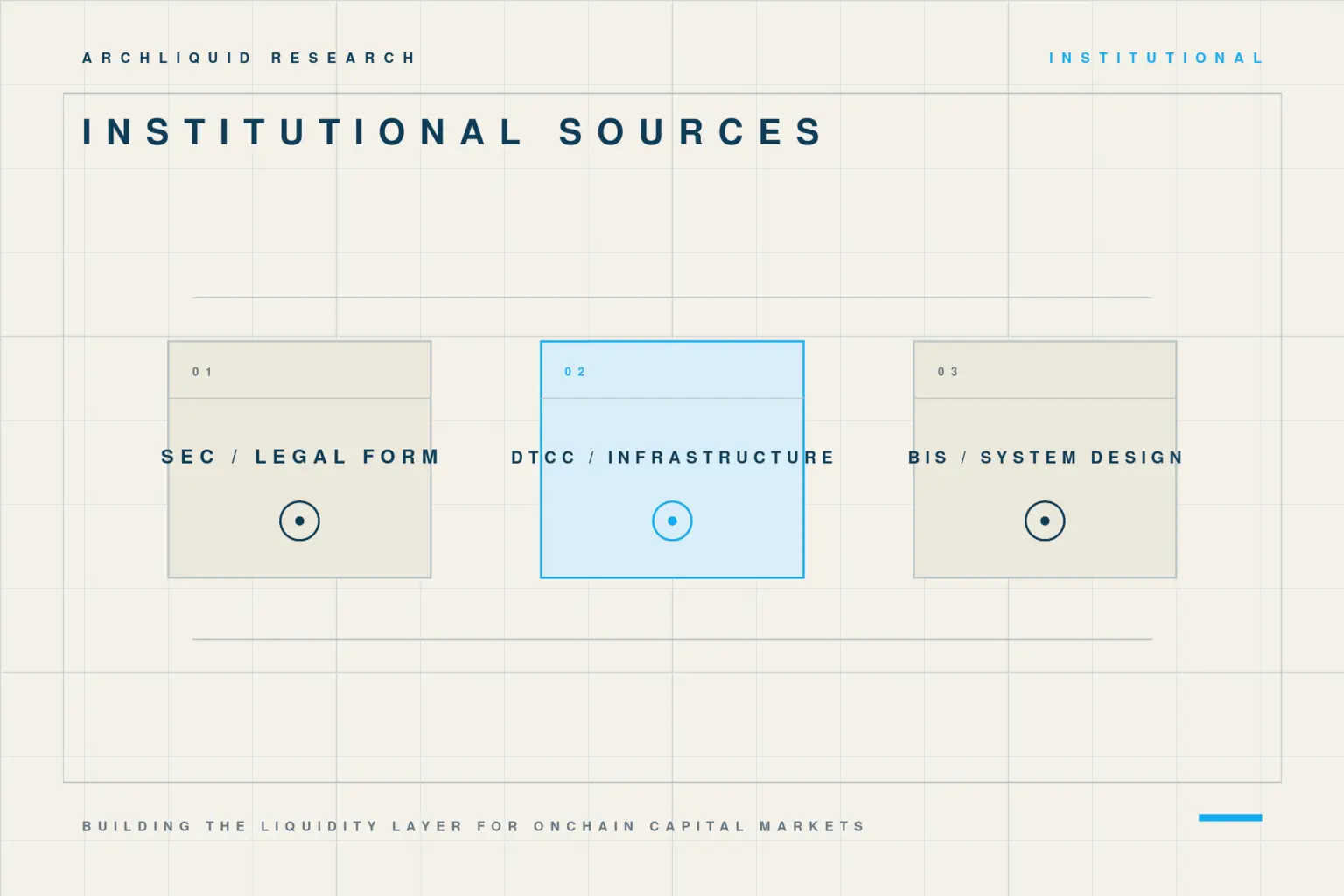
The SEC record addresses legal form, DTCC records describe authorized market infrastructure and production preparation, while BIS analysis examines the architecture of tokenized money and assets.
- SEC
- Instrument taxonomy
- DTC / DTCC
- Controlled service authorization
- BIS
- System architecture
- Research rule
- State exact scope
Tokenized securities remain securities; structures differ.
Defined DTC-custodied assets and production preparation.
Sound money, governance and unified-ledger analysis.
Authorization, testing and general availability are not synonyms.
Source: DTC authorized to offer tokenization service (DTCC).
Tokenized is a format, not one legal category
SEC staff's January 2026 statement describes tokenized securities and separates issuer-sponsored structures from unaffiliated third-party structures. The same underlying company can therefore be referenced by tokens with different issuers, holder rights and settlement obligations. The blockchain record does not collapse those differences.
For builders, this means asset metadata needs legal structure and authoritative issuer fields beside contract address. For researchers, it means market-size claims should not aggregate every token carrying a security ticker as though holders own the same instrument.
DTCC describes controlled production scope
DTC announced that it received authorization to offer a tokenization service for select DTC-custodied assets in a controlled production environment. Its announcement identified initial categories including Russell 1000 equities, major index ETFs and U.S. Treasury securities, with timing and participation governed by the initiative's rollout.
DTCC's tokenization material emphasizes that a tokenized entitlement can carry the same legal and economic rights as the traditional form and use a common CUSIP within its design. That is a specific infrastructure model, not evidence that every third-party stock token has DTC-recognized rights.
Production preparation is measurable
DTCC's live-production-trades page reports participation activity and an expected production launch timeline. Those records are useful because they name the operator, scope and stage. They should be quoted with their publication date, since future launch timing and participant counts can change.
The careful wording is authorized, tested, launched or generally available according to the source. Treating those stages as interchangeable inflates progress and makes later updates confusing. Institutional credibility is strengthened by precise milestone language.
BIS keeps money and governance in the design
BIS analysis presents tokenization as an opportunity to integrate messaging, reconciliation and settlement, while emphasizing central bank money and institutional governance. The technology can reduce fragmented processes, but the reliability of the monetary anchor and the rules around the ledger remain central.
This perspective is especially relevant to tokenized capital markets. A security leg and cash leg must settle under coherent rights and finality. Faster smart contracts do not solve an unstable settlement asset, unclear custody claim or bridge route with incompatible finality.
How to evaluate institutional claims
Prefer regulator, operator and standards-body records. Record the exact asset types, jurisdictions, participants, legal rights, production stage and date. Distinguish transactions run in a controlled environment from unrestricted public access, and distinguish a platform authorization from each asset issuer's authorization.
Then connect those records to live technical evidence: chain, contract, transaction, custody system and settlement route. Institutional tokenization is becoming concrete, but its progress is best understood through scoped facts rather than a single total-value headline.
Sources and further reading
Sources were accessed for this publication on August 4, 2026. Product terms, networks and deployments can change; check the linked primary source before acting.
Related reading
Real-World Asset Tokenization: What It Is and What It Does Not Change
Tokenization can make an asset programmable. It cannot, by itself, create ownership rights, remove counterparties, or make an illiquid market liquid.
What Are Tokenized Stocks? Ownership, Derivatives and Counterparty Risk
The phrase tokenized stock covers several legal structures. Price exposure, shareholder ownership and redemption rights are not interchangeable.
Robinhood Chain Explained: Architecture for Onchain Capital Markets
Robinhood Chain combines Ethereum-compatible execution with dedicated market infrastructure for tokenized assets. Here is what the architecture actually provides.