Chainlink Data Streams for Robinhood Chain RWAs: Reports, Verification and Policy
A signed report proves that configured data was attested. The consuming contract still decides whether that report is current and safe for a particular action.
Key takeaways
- Data Streams uses signed offchain reports that consumers verify onchain through a pull-based flow.
- Robinhood documents a mainnet VerifierProxy at 0xcE73c8ad08CBDEaCa6078BF0627C8fe0a9a536E7.
- Consumers must validate feed identity, timestamp, decimals, market status and token multiplier policy.
Authenticity first, application policy second
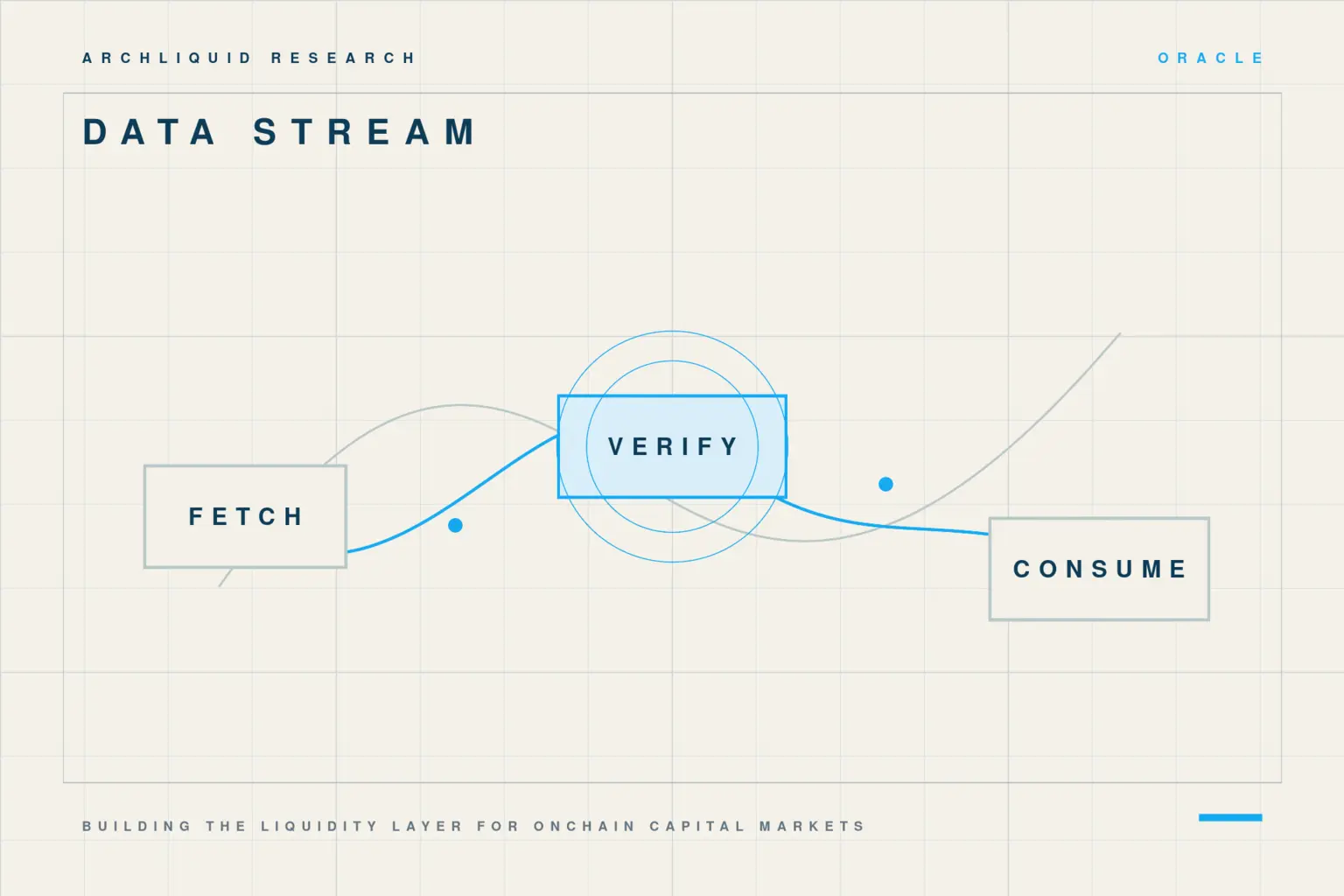
The report is fetched and submitted with the transaction, then checked through the documented VerifierProxy. After verification, the consuming contract applies feed ID, age and market-status rules.
- Robinhood VerifierProxy
- 0xcE73…36E7
- Delivery
- Pull-based
- Authenticity
- Signed report verification
- Suitability
- Protocol-specific policy
Mainnet address in Robinhood Chain documentation.
Report accompanies or precedes the consuming action.
Checks the report against the verifier system.
Feed, age, status and bounds remain consumer responsibilities.
Source: Data Streams on Robinhood Chain (Robinhood Chain Documentation).
Pull-based delivery changes the transaction flow
Chainlink Data Streams provides low-latency signed reports that are retrieved offchain and verified onchain. Unlike a contract that simply reads the latest value from a periodically updated storage feed, a pull-based consumer obtains report bytes and brings them into the transaction flow.
That design can provide fresher market data without writing every update onchain. It also means clients and contracts need explicit handling for report retrieval, verification fees, expiration and retry. The action should fail safely when a suitable report cannot be obtained.
Use the documented verifier for the exact network
Robinhood's documentation lists a VerifierProxy for Robinhood Chain mainnet. The address is network-scoped. A testnet address or similarly named contract is not interchangeable. Release manifests should record the chain ID, verifier address and code evidence used by the consumer.
Verification through a canonical proxy establishes that the report satisfies the verifier system. It does not identify which feed the application intended unless the consumer checks the feed identifier and report schema. Accepting any authentic feed can be as damaging as accepting an unauthenticated price.
Validate time, units and market state
The consumer should bound report age against the action's risk. It should also verify decimals and normalize values with checked arithmetic. Robinhood's stock-token documentation warns that raw REST bid and ask are not multiplier-adjusted while the onchain Chainlink feed is adjusted, so data-source policy must be explicit.
Real-world-asset reports can include market-status information. A recent report during a halt is authentic and fresh but can still be unsuitable for increasing debt or removing collateral. Separate timestamp and status conditions make that decision auditable.
Design for unavailable reports
A consumer should never treat failed retrieval as permission to use an unbounded old value. Define which actions remain available without a current report. Repayment and adding collateral often reduce risk; opening debt or withdrawing collateral increases it.
Fallback sources can improve availability only if their semantics, decimals and market coverage are compatible. A second source that updates on a different schedule may create inconsistent liquidation decisions. Monitor divergence and make transitions explicit rather than silently swapping feeds.
Test the bytes-to-decision path
Unit tests should cover wrong feed IDs, expired reports, future timestamps, malformed bytes, unexpected decimals, halt states and boundary values. Integration tests should retrieve a real report for the target network and execute the same verifier and consumer calls used in production.
User interfaces should expose source name, observation time and degraded state near material risk actions. Oracle branding alone is not a control. The defensible result comes from exact network wiring, authenticated report handling and a clear consumer policy.
Sources and further reading
Sources were accessed for this publication on August 4, 2026. Product terms, networks and deployments can change; check the linked primary source before acting.
Related reading
Real-World Asset Tokenization: What It Is and What It Does Not Change
Tokenization can make an asset programmable. It cannot, by itself, create ownership rights, remove counterparties, or make an illiquid market liquid.
What Are Tokenized Stocks? Ownership, Derivatives and Counterparty Risk
The phrase tokenized stock covers several legal structures. Price exposure, shareholder ownership and redemption rights are not interchangeable.
Robinhood Chain Explained: Architecture for Onchain Capital Markets
Robinhood Chain combines Ethereum-compatible execution with dedicated market infrastructure for tokenized assets. Here is what the architecture actually provides.