Trading Halts in Tokenized Stock Markets: Pricing, Oracles and Protocol Safety
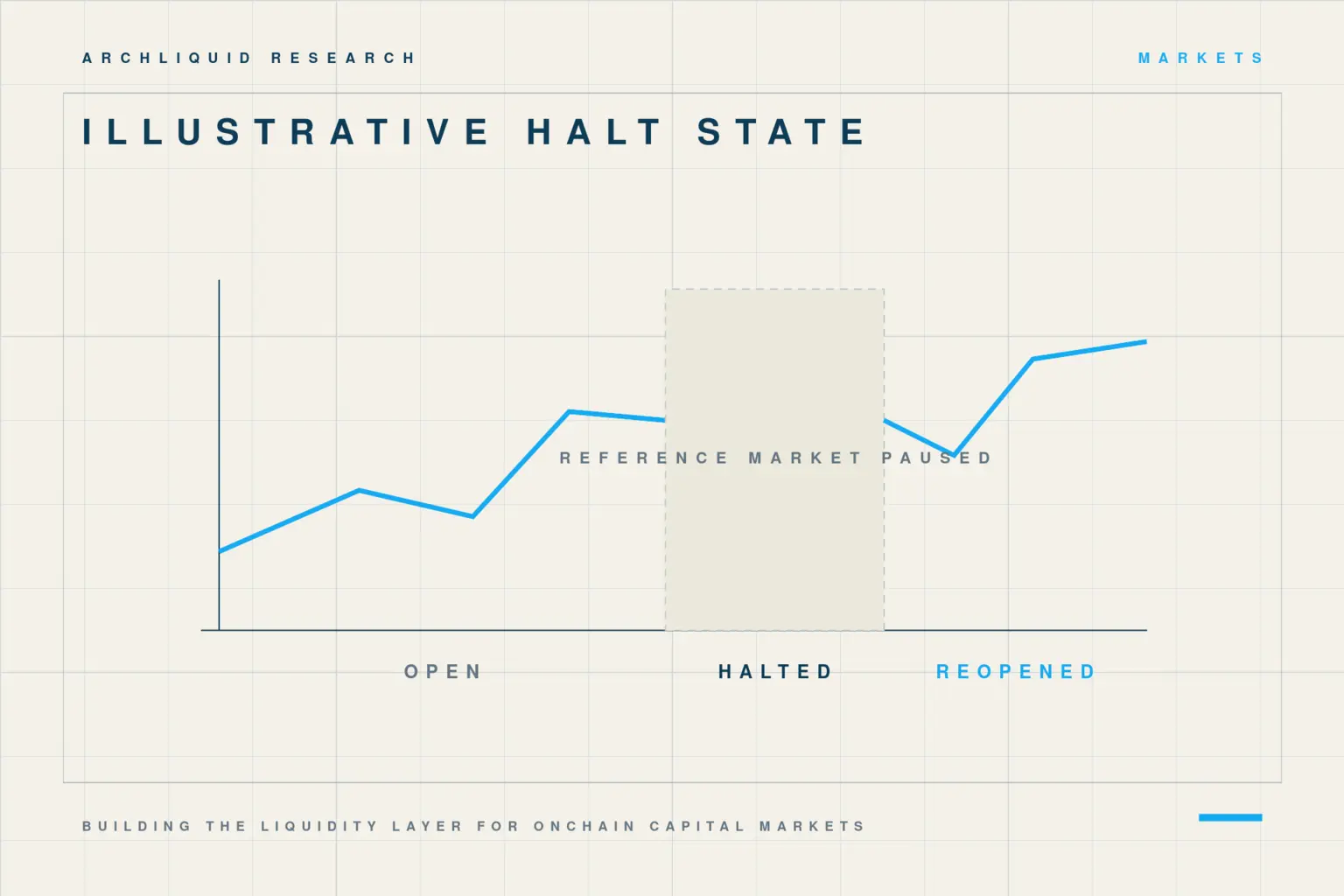
A blockchain can keep producing blocks while the reference stock stops trading. Protocols need a policy for that information gap before it happens.
Key takeaways
- Block production and token transferability do not prove that the reference market is producing an executable price.
- Market makers may widen, withdraw or move out of range during a halt, increasing onchain price impact.
- Lending and trading systems need explicit freshness, halt, deviation and recovery rules.
A fresh timestamp can still accompany a halted underlier
Assume an oracle report is 20 seconds old but its market-status field says the underlying is halted. A 60-second freshness rule passes, yet a protocol policy can still block new borrowing because the price-discovery state is degraded.
- Report age
- 20 seconds
- Market status
- Halted
- Allow
- Repay + add collateral
- Restrict
- New borrow
Hypothetical value under a 60-second freshness threshold.
Separate state from timestamp freshness.
Risk-reducing actions can remain available.
Illustrative policy until a validated recovery condition.
This is a policy example, not a universal recommendation. Exact controls depend on the instrument, feed and protocol terms.
A halt stops a reference process, not the chain
A reference exchange can pause a stock because of news, volatility or an operational event while Robinhood Chain continues to settle blocks. The token contract may remain transferable and an AMM may remain callable. That technical availability does not mean the reference asset has a current executable market price.
Robinhood's documented stock-price API includes a trading-halt field. Chainlink Data Streams documentation also describes market-status information for real-world-asset feeds. Applications should ingest status as a first-class risk input rather than assuming that a recent numeric value is sufficient.
AMMs continue calculating from pool state
An automated market maker does not ask whether a stock exchange is halted before applying its curve unless custom logic is added. Trades update reserves or concentrated-liquidity state mechanically. During the information gap, better-informed traders can transact against liquidity priced from the last known reference.
Liquidity providers may respond by removing capital or positioning it away from the current range. That can sharply increase price impact for users who interpret continuous transfer as continuous liquidity. Displaying the last pool price without depth, status and timestamp conceals the change in market quality.
Freshness and market status answer different questions
A freshness rule asks how recently a report was produced. A market-status rule asks whether the underlying price-discovery process is operating normally. A feed can update promptly with a halted status, and an old report can show the market as open. Protocol logic needs to evaluate both.
Deviation checks add a third dimension by comparing sources or the last accepted value. They can detect abrupt divergence but should not turn another delayed price into a false authority. Each input needs its own failure state and monitoring so operators can explain why an action was accepted or blocked.
Prefer risk-reducing recovery paths
A lending market can treat actions asymmetrically during degraded data. Repayment and adding collateral reduce exposure; new borrowing and collateral withdrawal increase it. Liquidation policy is harder because freezing can accumulate bad debt while liquidating against an unreliable value can harm borrowers unfairly.
There is no universal halt response. The correct design depends on oracle guarantees, issuer redemption, market hours and collateral concentration. What matters is that the policy is explicit, tested and visible before the event rather than improvised by an administrator during stress.
Define the return to normal
A market-open flag alone may not justify immediate recovery. Protocols can require several valid reports, bounded deviation and restored liquidity before enabling risk-increasing actions. The rule should prevent rapid toggling when status changes around a volatile reopening.
Interfaces should show the affected asset, observed status, last trusted price and currently available actions. Event logs and monitoring should preserve every policy transition. That record makes a halt response reviewable instead of reducing it to a generic oracle error banner.
Sources and further reading
Sources were accessed for this publication on August 4, 2026. Product terms, networks and deployments can change; check the linked primary source before acting.
Related reading
Tokenized Stock Liquidity: From Market Hours to Onchain AMMs
A token may transfer continuously even when its reference market is closed. That creates access, but it also changes price discovery and risk.
Settlement Assets on Robinhood Chain: ETH, USDG and the Cash Leg
Every tokenized-stock trade has a cash leg. Its contract, liquidity and redemption path matter as much as the asset being purchased.
Cross-Chain RWA Settlement: Bridge Finality, Token Mapping and Failure States
A source-chain transaction can be final while the destination asset is still pending. Good settlement design exposes every state between those events.