Settlement Assets on Robinhood Chain: ETH, USDG and the Cash Leg
Every tokenized-stock trade has a cash leg. Its contract, liquidity and redemption path matter as much as the asset being purchased.
Key takeaways
- Robinhood Chain uses ETH to pay transaction fees, while trading applications can use separate quote or settlement tokens.
- A stable price label does not remove issuer, reserve, bridge, liquidity or smart-contract risk.
- Markets need enough quote-asset depth and a credible exit path to settle tokenized-stock trades reliably.
A stock-token trade still needs both gas and a cash leg
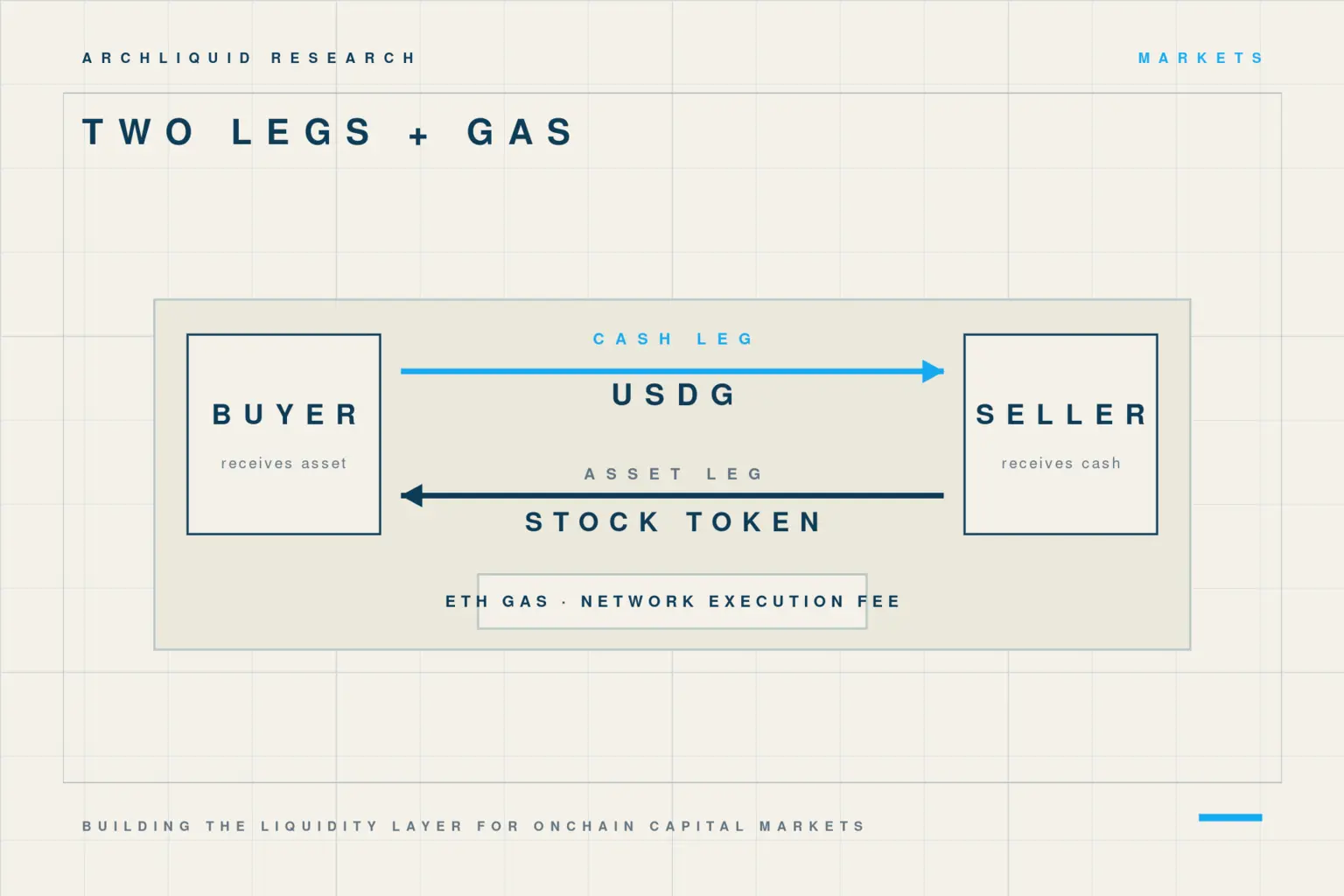
Swapping a stock-linked token against USDG uses ETH to execute the transaction and USDG to settle the quoted value. The two assets carry different roles and risks.
- Gas asset
- ETH
- Quote asset
- USDG
- Asset leg
- Stock Token
- Final state
- Two wallet balances
Pays Robinhood Chain transaction fees.
Canonical address is listed by Robinhood Chain documentation.
Identity and rights depend on its own contract and terms.
Execution success does not guarantee either asset holds a target market price.
Source: Robinhood Chain contract addresses (Robinhood Chain Documentation).
Why the cash leg deserves scrutiny
A tokenized-stock market has at least two assets: the stock-linked token and the asset received in exchange. Attention often stays on the stock side, but the quote asset determines how traders measure value, how market makers rebalance and how lending protocols account for proceeds. If that settlement asset becomes illiquid or loses its reference value, a correctly functioning stock token can still become difficult to trade.
The cash leg is not automatically bank cash. Onchain it is another contract with an issuer, supply mechanism, transfer rules and market price. A user should be able to identify the exact contract and understand whether redemption is direct, intermediary-dependent, bridged or available only to eligible participants.
ETH pays for execution
Robinhood's network documentation identifies ETH as the native currency for both Robinhood Chain mainnet and testnet. ETH pays gas for wallet transfers and contract calls. Holding a dollar-denominated token does not remove the need for ETH unless an application deliberately sponsors fees through a separate mechanism.
Gas and settlement are different functions. A user may pay ETH to swap a stock token against USDG, or pay ETH to supply either asset to a lending market. Interfaces should show both requirements before signature so a user does not acquire a tradable asset and then discover that the wallet lacks gas to move it.
USDG and canonical identity
Robinhood publishes canonical network contract addresses, including its supported asset contracts. Integrations should use that registry rather than matching a symbol such as USDG. A counterfeit can copy the name and decimals of a legitimate settlement token while having no connection to its issuer or reserves.
Contract identity is only the first check. Builders should document the token's issuer, applicable terms, mint and redemption model, upgrade controls and any freeze or compliance functions. Those properties determine who can convert the token, which events can interrupt transfer and how losses would be allocated if an intermediary fails.
Liquidity and depeg mechanics
A dollar reference is an objective, not a mathematical guarantee. Market price can move away from one dollar when redemption is constrained, reserves are questioned or onchain liquidity is shallow. An AMM can continue producing a price during stress, but that price reflects pool inventory and order flow rather than a promise that every holder can redeem at par.
Protocols should measure settlement-token exposure separately from stock-token exposure. Lending parameters need liquidity thresholds and conservative oracle rules. Market makers need more than one route to rebalance. Treasury dashboards should avoid reporting all dollar-denominated tokens as identical cash without showing the contract and valuation source.
A settlement-asset checklist
Before integrating a quote asset, verify the chain ID, canonical address, live bytecode, decimals and transfer behavior. Review issuance and redemption terms, reserve disclosures, bridge dependencies, administrative powers, oracle coverage, pool depth and concentration of holders. Test approvals, transfers and emergency states against the exact deployed contract.
For users, a practical interface identifies the quote asset beside every price, links to its canonical contract and estimates both price impact and gas. For builders, the aim is not to label one asset risk-free. It is to make the distinct risks of execution, settlement and the referenced security visible enough to manage independently.
Sources and further reading
Sources were accessed for this publication on August 4, 2026. Product terms, networks and deployments can change; check the linked primary source before acting.
Related reading
Tokenized Stock Liquidity: From Market Hours to Onchain AMMs
A token may transfer continuously even when its reference market is closed. That creates access, but it also changes price discovery and risk.
Trading Halts in Tokenized Stock Markets: Pricing, Oracles and Protocol Safety
A blockchain can keep producing blocks while the reference stock stops trading. Protocols need a policy for that information gap before it happens.
Cross-Chain RWA Settlement: Bridge Finality, Token Mapping and Failure States
A source-chain transaction can be final while the destination asset is still pending. Good settlement design exposes every state between those events.