Tokenized Stock Liquidity: From Market Hours to Onchain AMMs
A token may transfer continuously even when its reference market is closed. That creates access, but it also changes price discovery and risk.
Key takeaways
- Transfer availability and reliable price discovery are different properties.
- When the reference market is closed or halted, AMM prices can carry a larger uncertainty premium.
- Deep liquidity requires market makers, settlement assets, arbitrage paths and reliable lifecycle data.
Why a small pool can move far from the reference market
In a simplified constant-product pool with 100 stock tokens and 10,000 quote units, buying 10 stock tokens moves the reserve ratio before fees from 100 to about 123.46 quote units per token.
- Starting reserves
- 100 stock / 10,000 quote
- Invariant
- x × y = 1,000,000
- After buying 10
- 90 stock / 11,111.11 quote
- New reserve ratio
- 123.46
Initial reserve ratio: 100 quote per stock token.
Simplified V2-style constant-product model, ignoring fees.
Quote reserve required to preserve the invariant.
A 23.46% move before fees and external arbitrage.
Illustrative constant-product arithmetic. It is not a live Robinhood Chain pool quote and excludes fees, routing and concentrated liquidity.
Liquidity is more than a tradable contract
Deploying a token and a pool does not create a liquid market. Liquidity means participants can transact meaningful size with acceptable price impact and a credible path for prices to return toward fair value. That requires capital, active market makers, dependable settlement assets, arbitrage routes and confidence in the token's legal and operational structure.
Tokenized stocks add another layer because they reference assets whose primary price discovery may occur on regulated exchanges with defined sessions and halt rules. The onchain market can be open while the reference venue is closed. The resulting price can be useful, but it may represent expectations and risk premia rather than an immediately arbitrageable stock price.
Market hours and continuous transfer
Continuous blockchain settlement can make a token transferable outside conventional market hours. Robinhood's stock-token metadata separately exposes underlying tradability, all-day tradability and extended-hours fractional capabilities. Those fields show why applications should avoid a simplistic open-or-closed assumption.
When the underlier is not trading, market makers face uncertainty about the next opening price. They may widen spreads, reduce liquidity or stop quoting. An AMM cannot widen a displayed spread in the same way as an order book, but liquidity providers can withdraw or concentrate capital away from the current price. Thin pools can therefore move sharply on modest order flow.
How AMM price discovery works
An automated market maker computes prices from pool state. In a simple constant-product pool, a trade changes the relative reserves and therefore the next price. Concentrated-liquidity systems let providers place capital inside chosen ranges, improving efficiency near an expected price but creating inactive liquidity outside that range.
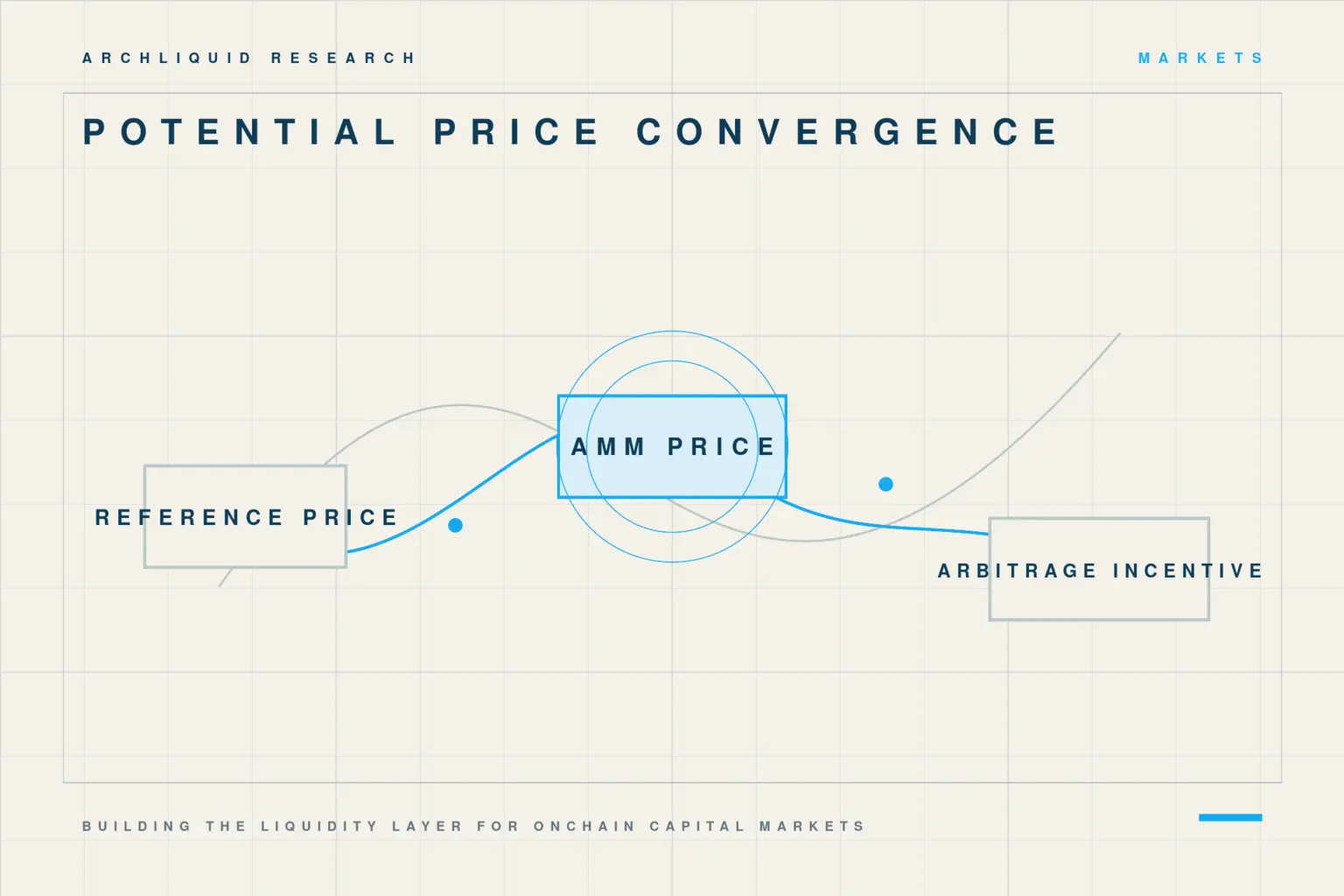
Arbitrage connects an AMM to other venues. If a token can be created, redeemed or traded elsewhere, price differences invite participants to buy on one venue and sell on another. That process is constrained by fees, bridge times, eligibility, market hours and redemption rules. A visible price gap is not necessarily a free trade.
Halts, stale data and adverse selection
A trading halt removes or weakens the external reference that liquidity providers use. Participants with better information may trade against a pool whose price has not adjusted, leaving passive providers with losses when markets reopen. Oracle consumers face a related problem if they accept an old price as current collateral value.
Interfaces should expose reference-market status and last-update time. Lending protocols need explicit freshness and halt policies. Pool designers may choose dynamic fees or hook-based controls, but those mechanisms add code and governance risk. The correct response depends on the asset and user promise, not on a universal assumption that twenty-four-hour trading is always beneficial.
What healthy tokenized-stock liquidity needs
A durable market connects canonical asset identity, authoritative lifecycle data, reliable token-level pricing, robust settlement assets and multiple liquidity sources. It also gives market makers a workable creation or redemption path. Without those elements, reported volume can overstate the market's ability to absorb stress.
For users, the practical checks are pool depth, recent volume, price impact, reference-market status and exit routes. For builders, the standard is higher: simulate closed markets, halts, corporate actions, bridge delays and oracle failures before treating a tokenized equity like ordinary always-on collateral.
Sources and further reading
Sources were accessed for this publication on August 4, 2026. Product terms, networks and deployments can change; check the linked primary source before acting.
Related reading
Settlement Assets on Robinhood Chain: ETH, USDG and the Cash Leg
Every tokenized-stock trade has a cash leg. Its contract, liquidity and redemption path matter as much as the asset being purchased.
Trading Halts in Tokenized Stock Markets: Pricing, Oracles and Protocol Safety
A blockchain can keep producing blocks while the reference stock stops trading. Protocols need a policy for that information gap before it happens.
Cross-Chain RWA Settlement: Bridge Finality, Token Mapping and Failure States
A source-chain transaction can be final while the destination asset is still pending. Good settlement design exposes every state between those events.