The Tokenized Capital Markets Risk Checklist: Rights, Custody, Liquidity and Oracles
The word tokenized describes a technical form. A sound review asks what the token represents, who stands behind it and how it behaves under stress.
Key takeaways
- Start with holder rights and issuer structure before evaluating the token contract or market price.
- Treat custody, liquidity, oracle, bridge and governance risks as separate layers.
- Verify claims against primary documents and live onchain evidence rather than names, badges or screenshots.
Do not let one green check hide four unresolved risks
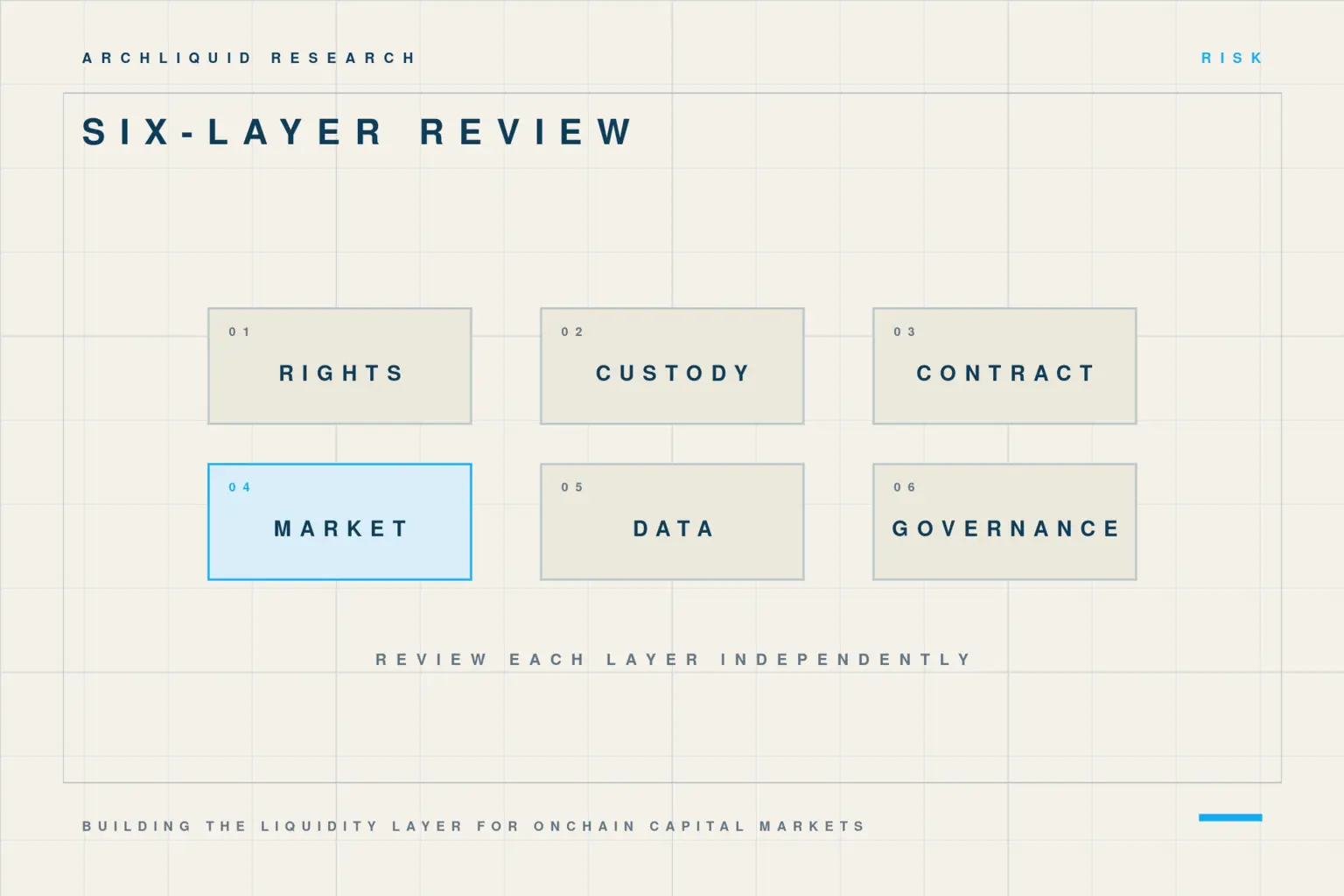
A verified contract can still represent weak rights, depend on concentrated custody, trade in a thin market or consume stale data. Review each layer independently and preserve the unresolved state.
- Rights
- Terms + jurisdiction
- Custody
- Asset control
- Contract
- Canonical + verified
- Market
- Depth + exit
- Data
- Freshness + status
- Governance
- Who can change what
What can the holder legally enforce?
Who controls backing assets and under what segregation?
Which chain, address, implementation and admin?
Can a holder transact meaningful size under stress?
How do halts, splits and stale prices propagate?
Map upgrade, pause and emergency authorities.
This checklist is a research aid, not legal, investment or compliance advice.
1. Identify the legal instrument
Ask what the token legally represents. It may be an issuer-sponsored security, a beneficial interest held through an intermediary, a derivative linked to a share price or a token with no enforceable connection to the named asset. Read the governing terms, eligible jurisdictions, transfer restrictions, redemption rights, voting treatment, dividend treatment and insolvency provisions.
Regulatory classification does not disappear because the record is on a blockchain. SEC staff has emphasized that tokenized securities remain securities. Robinhood Europe also explains that its Classic Stock Tokens are derivative contracts rather than ownership of the actual shares. Product labels must not blur those distinctions.
- Who is the legal issuer and which entity owes the holder an obligation?
- Does the holder own, beneficially own, or only receive economic exposure to the reference asset?
- Who can mint, burn, redeem, freeze or restrict transfers?
2. Map issuer, custodian and counterparty risk
If an intermediary holds underlying assets, identify the custodian and the segregation arrangement. Determine whether token supply is reconciled with assets, how often reports are produced and what happens if the issuer or custodian becomes insolvent. An onchain reserve balance may be useful evidence, but it may not show offchain liabilities or legal priority.
Where the instrument is synthetic or derivative, review the counterparty and collateral model. A close price relationship in normal markets does not guarantee payment during default. The BIS discussion of tokenisation stresses that institutional arrangements and sound money remain central even when the ledger technology changes.
3. Verify the technical identity
Record the chain ID and canonical checksummed contract from an issuer or protocol source. Confirm live bytecode, proxy implementation, upgrade authority, decimals and pause or transfer-control functions. Do not identify a token by ticker, name or logo. Counterfeit contracts can reproduce all three.
For a liquidity position, validate the canonical factory or position manager. For a bridge representation, trace the mapping and escrow route. For a protocol integration, compare the deployed runtime with the reviewed source and inspect constructor or initializer wiring. Technical due diligence is about the exact deployment, not a repository in the abstract.
4. Evaluate price and liquidity
Identify the reference price, update method, timestamp, decimals and treatment of stock-token multipliers. Understand what happens outside the underlying market's session and during a trading halt. A price can be cryptographically authentic yet stale, calculated for the underlying rather than the token, or unavailable when risk actions are most urgent.
Inspect pool depth, recent volume, concentration, price impact and market-maker exit routes. Continuous transfer does not imply continuous institutional liquidity. A locked LP position can reduce withdrawal discretion while remaining out of range, imbalanced or exposed to adverse selection. Treat a lock as evidence of custody and time, not as a promise of stable value.
5. Review bridges, settlement and governance
List every chain and bridge on the route between purchase and redemption. Review message validation, finality, pause controls and destination-token mapping. Separately assess the settlement asset: its issuer, redemption path, liquidity and depeg exposure. Gas assets, quote assets and the tokenized security perform different jobs and can fail independently.
Finally, map governance. Identify upgrade keys, emergency councils, timelocks and validator assumptions. Robinhood publishes its chain governance model, including council thresholds and delayed routine actions. Application contracts built on the chain have their own roles, so chain governance does not replace protocol-level review.
How to use the checklist
Write each conclusion beside a primary source or live onchain observation and add the date checked. Mark unknowns as unknown. Avoid converting the absence of a reported incident into proof of safety, or source verification into proof of correctness. Different evidence answers different questions.
The objective is not a single risk score. It is a map of legal, counterparty, technical and market dependencies that lets a user decide whether the instrument matches their needs. Tokenized capital markets become more credible when those dependencies are easier to inspect, not when the word onchain is used to make them disappear.
Sources and further reading
Sources were accessed for this publication on August 4, 2026. Product terms, networks and deployments can change; check the linked primary source before acting.
- 01Statement on Tokenized SecuritiesU.S. Securities and Exchange Commission Staff
- 02Enchanting, but Not Magical: A Statement on the Tokenization of SecuritiesU.S. Securities and Exchange Commission
- 03About Classic Stock TokensRobinhood Europe
- 04The next-generation monetary and financial systemBank for International Settlements
- 05Robinhood Chain GovernanceRobinhood Chain Documentation
Related reading
Real-World Asset Tokenization: What It Is and What It Does Not Change
Tokenization can make an asset programmable. It cannot, by itself, create ownership rights, remove counterparties, or make an illiquid market liquid.
Tokenized ETFs vs Tokenized Stocks: Exposure, Rights, Pricing and Liquidity
A token linked to one company and a token linked to a portfolio can share an ERC-20 interface while carrying very different valuation and lifecycle dependencies.
Private-Company Stock Tokens: Exposure, Valuation and Liquidity Limitations
A private-company name can make a token feel familiar while the underlying reference remains unlisted, infrequently priced and inaccessible to the holder.