Private-Company Stock Tokens: Exposure, Valuation and Liquidity Limitations
A private-company name can make a token feel familiar while the underlying reference remains unlisted, infrequently priced and inaccessible to the holder.
Key takeaways
- A private-company token may provide derivative exposure without ownership, voting or information rights in the referenced company.
- Unlisted shares can lack continuous observable pricing, making token liquidity and valuation especially dependent on the wrapper.
- Marketing names should never substitute for the governing terms, counterparty structure and available exit route.
A derivative reference is not a share certificate
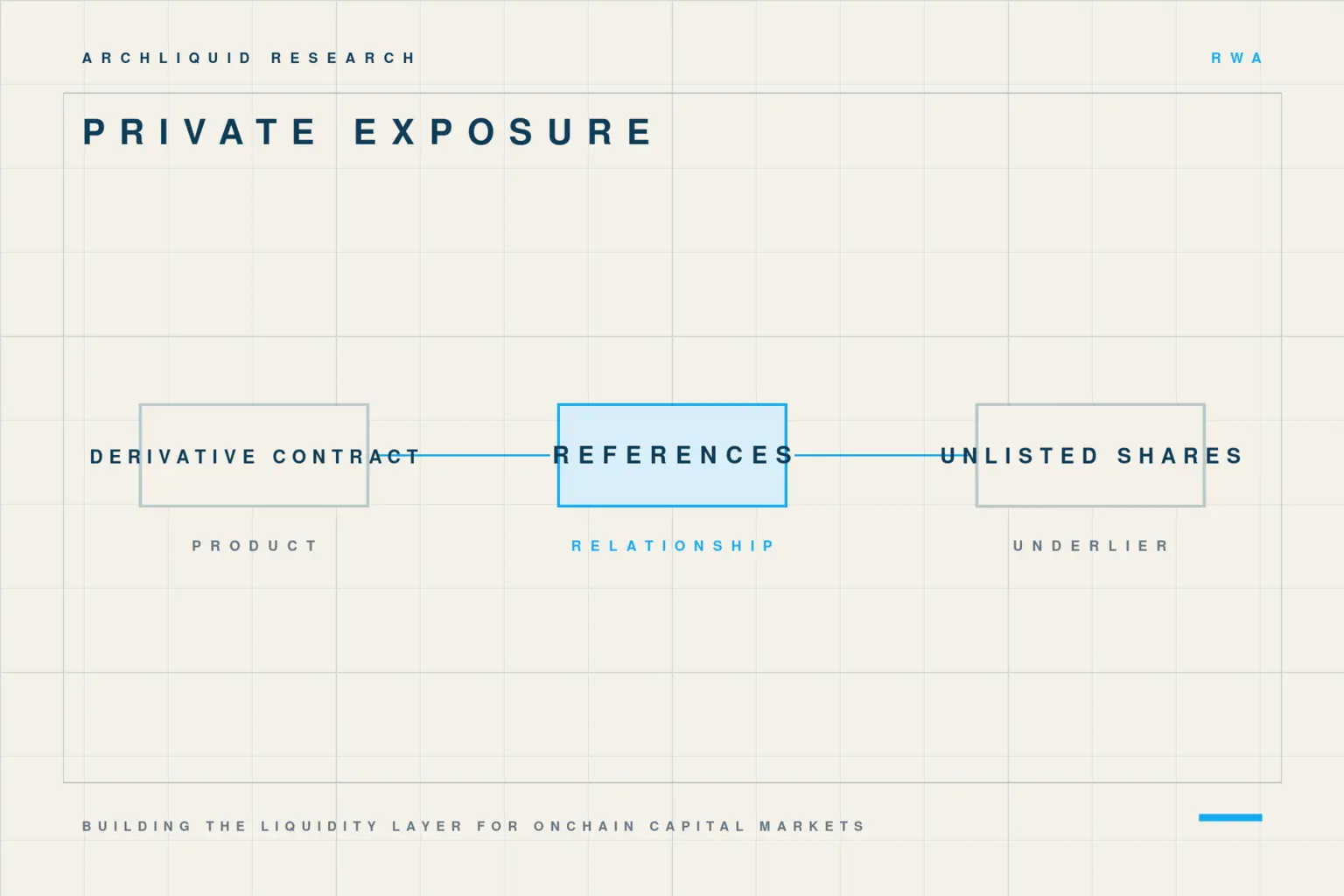
Robinhood Europe's historical private-stock promotion terms describe derivative contracts and say recipients do not receive rights to underlying private-company stock. They also describe unlisted shares as not actively traded.
- User holds
- Derivative contract
- User does not hold
- Underlying private stock
- Reference market
- Unlisted
- Key dependency
- Contractual payoff
According to the cited historical promotion terms.
No direct rights to the referenced shares under those terms.
The terms note that private stock is not actively traded.
Value realization follows the issuer's product structure.
Source: Private Stock Giveaway terms and conditions (Robinhood Europe).
Private-market exposure needs unusually precise labels
A private company has no continuously traded public share price and its securities can be subject to transfer restrictions. A token carrying the company's name may represent a derivative contract, an interest in a special-purpose vehicle or another product rather than equity recorded on the company's capitalization table.
That distinction determines voting, information, dividend and insolvency rights. It also determines who owes the holder value. A smart contract can enforce token transfers while the economic promise remains an obligation of the product issuer under offchain terms.
Read the actual product structure
Robinhood Europe's historical private-stock giveaway terms describe the awarded instruments as derivative contracts and state that recipients do not acquire the underlying private-company shares. The terms also discuss hedging through special-purpose vehicles. Those details are more informative than a token symbol or company logo.
This example should not be generalized to every future product. It demonstrates the research method: identify the named legal entity, contract type, governing law, payoff formula, maturity or redemption terms and circumstances in which the issuer can restrict or terminate the product.
Valuation lacks a continuous public anchor
Private shares may be valued through funding rounds, secondary transactions, independent appraisals or model inputs. Those observations can be infrequent and can refer to different share classes with different rights. A token quote that updates continuously can therefore appear more precise than the underlying evidence supports.
Interfaces should disclose source date and methodology, not only a current number. Lending systems need conservative staleness and concentration policies because a delayed mark can persist through material company events. A liquid token market can discover its own price, but that price may reflect wrapper and exit risk as much as company value.
Onchain liquidity does not create underlying liquidity
An AMM can allow continuous transfers between token holders, yet market makers still need a way to value and hedge their exposure. If the underlying private security cannot be freely bought, sold or redeemed, arbitrage cannot reliably pull the token toward a single external value.
Pool depth, withdrawal concentration and counterparty inventory become central. A visible last trade can be generated by small size. Users should inspect price impact and settlement rights rather than assuming that a twenty-four-hour interface makes the referenced private stock itself liquid.
A practical private-token review
Separate the reference company from the product issuer. Record the legal instrument, payoff, underlying hedge, valuation source, fees, transfer restrictions and eligible jurisdictions. Then verify the chain, contract, upgrade roles and available market depth. Unknowns should remain visible rather than being filled with assumptions from public equities.
Private-market tokenization can expand distribution and programmable settlement, but it also concentrates attention on product terms and valuation governance. Clear separation between company equity and token exposure is the foundation for every later technical or market claim.
Sources and further reading
Sources were accessed for this publication on August 4, 2026. Product terms, networks and deployments can change; check the linked primary source before acting.
Related reading
Real-World Asset Tokenization: What It Is and What It Does Not Change
Tokenization can make an asset programmable. It cannot, by itself, create ownership rights, remove counterparties, or make an illiquid market liquid.
The Tokenized Capital Markets Risk Checklist: Rights, Custody, Liquidity and Oracles
The word tokenized describes a technical form. A sound review asks what the token represents, who stands behind it and how it behaves under stress.
Tokenized ETFs vs Tokenized Stocks: Exposure, Rights, Pricing and Liquidity
A token linked to one company and a token linked to a portfolio can share an ERC-20 interface while carrying very different valuation and lifecycle dependencies.