Robinhood Chain Testnet Transactions: Wallet, Gas, Explorer and Revert Checks
A connected wallet is not yet ready to transact. Network, signer, gas, contract code and simulation must all agree before the request is meaningful.
Key takeaways
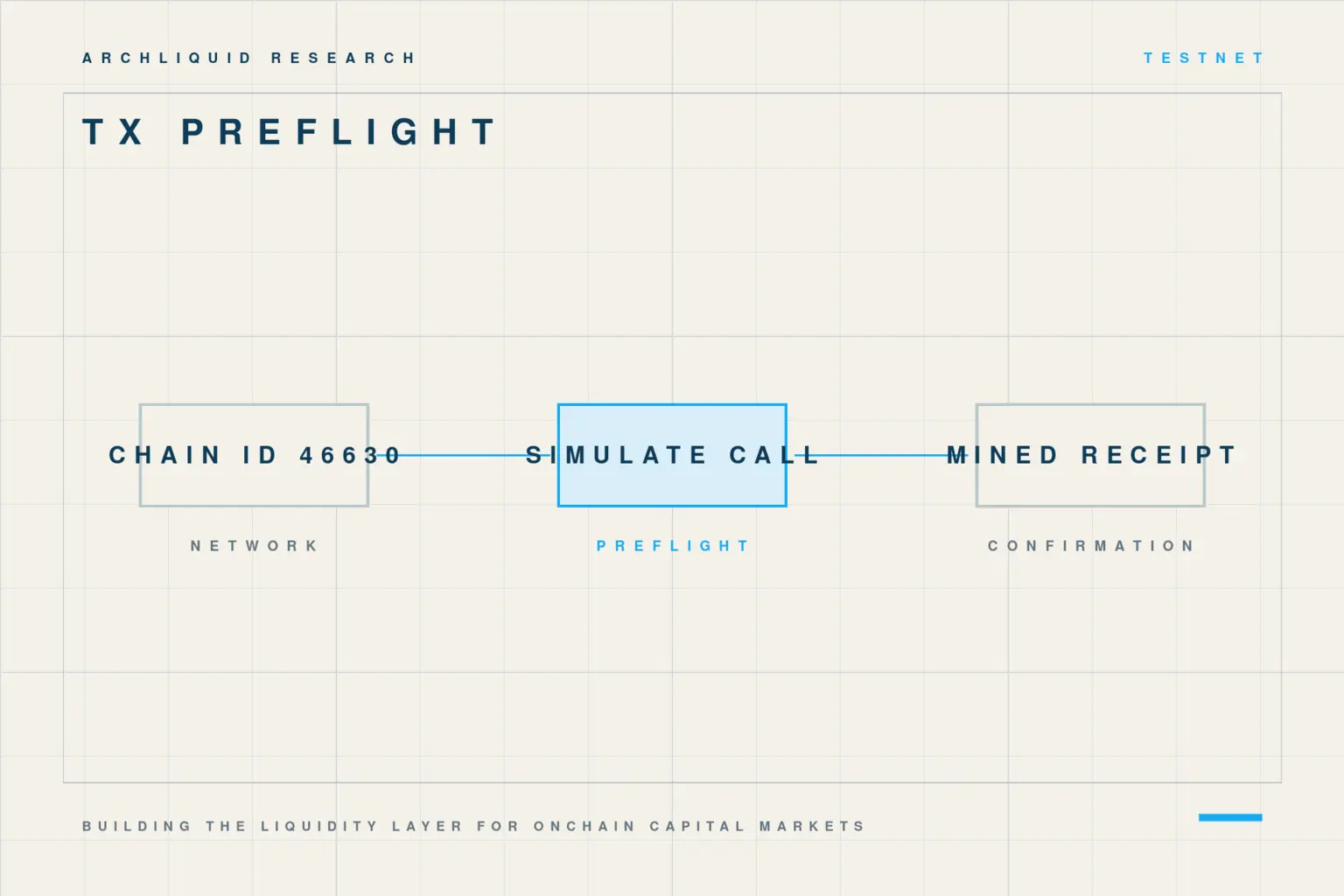
- Robinhood Chain testnet uses chain ID 46630 and ETH for gas; wallet connection alone does not enforce either state.
- Confirm target code and simulate the exact calldata before opening the wallet signature request.
- A transaction is complete only after a successful mined receipt and application-state reconciliation.
Five checks before the wallet opens
The example sequence blocks an action until the wallet account, chain ID, ETH balance, target code and simulation all pass for the same current state.
- Network
- 46630
- Gas
- ETH balance > estimate
- Target
- eth_getCode ≠ 0x
- Simulation
- No revert
Robinhood Chain testnet.
Include a margin for gas-price movement.
Contract code must exist at the testnet address.
Use the exact account, value and calldata intended for broadcast.
This is a transaction-safety workflow, not a guarantee that a particular contract action is economically safe.
Source: Connecting to Robinhood Chain (Robinhood Chain Documentation).
Connection and network are separate states
A wallet connection gives the application access to an account address and provider. The active provider can still be on another EVM network. Read the chain ID immediately and after every return from a mobile wallet, then compare it with Robinhood Chain testnet ID 46630.
If the network is missing, request addition using Robinhood's published configuration. If it exists but is inactive, request a switch. Wait for the wallet to confirm and re-read chain state. Do not enable transactions merely because the switch request promise resolved.
Check the current signer and ETH balance
Embedded browsers and WalletConnect sessions can remain linked while the user changes the selected account inside the wallet. Read the current account again before simulation and display its shortened address beside the action. Preserve unsent form data, but invalidate approvals or simulations created for another account.
Robinhood Chain testnet uses ETH for gas. Estimate the transaction with the current sender, target, value and calldata, then compare the estimate with the wallet's ETH balance. Mock ERC-20 balances cannot pay gas unless a separate sponsorship system is active.
Prove the contract exists on testnet
A mainnet address may have no code at the same address on testnet. Call eth_getCode through the selected testnet provider and require a non-empty result before building a contract action. Then compare the address with the testnet deployment manifest and explorer.
For proxy systems, also confirm the implementation and dependency wiring. An interface should not present a module as live merely because source code exists in a repository. Network-specific deployment, verification and lifecycle transactions establish public support.
Simulate the exact transaction
Use an eth_call or wallet simulation with the same sender, target, value and calldata intended for broadcast. Common reverts include wrong network, missing allowance, insufficient balance, expired deadline, unauthorized role and early unlock. Decode known errors into a specific message where possible.
Simulation is a snapshot, not a reservation. Pool prices, allowances and roles can change before mining. Use slippage and deadline bounds and re-simulate after material state changes. The wallet's final confirmation remains necessary even after a clean simulation.
Follow the receipt to application state
After broadcast, show the testnet explorer link and mark the action pending. A transaction hash does not prove success. Wait for a mined receipt, check its status and parse expected events. A reverted receipt still consumes gas and must not update the interface as successful.
Finally, re-read balances, allowances, ownership or protocol position from the chain. This reconciliation catches indexer lag and optimistic-state errors. Store the transaction and resulting object identifier so the user can return to a durable activity record.
Sources and further reading
Sources were accessed for this publication on August 4, 2026. Product terms, networks and deployments can change; check the linked primary source before acting.
Related reading
Robinhood Stock Token API Integration: Assets, Prices and Corporate Actions
The API exposes identity, market data and lifecycle events, but raw REST quotes and onchain feed values require different multiplier handling.
How to Read a Robinhood Chain Contract in Blockscout: A Practical Guide
An explorer turns chain data into a useful interface, but the address, network and underlying RPC state remain the authority.
Real-World Asset Tokenization: What It Is and What It Does Not Change
Tokenization can make an asset programmable. It cannot, by itself, create ownership rights, remove counterparties, or make an illiquid market liquid.