How to Read a Robinhood Chain Contract in Blockscout: A Practical Guide
An explorer turns chain data into a useful interface, but the address, network and underlying RPC state remain the authority.
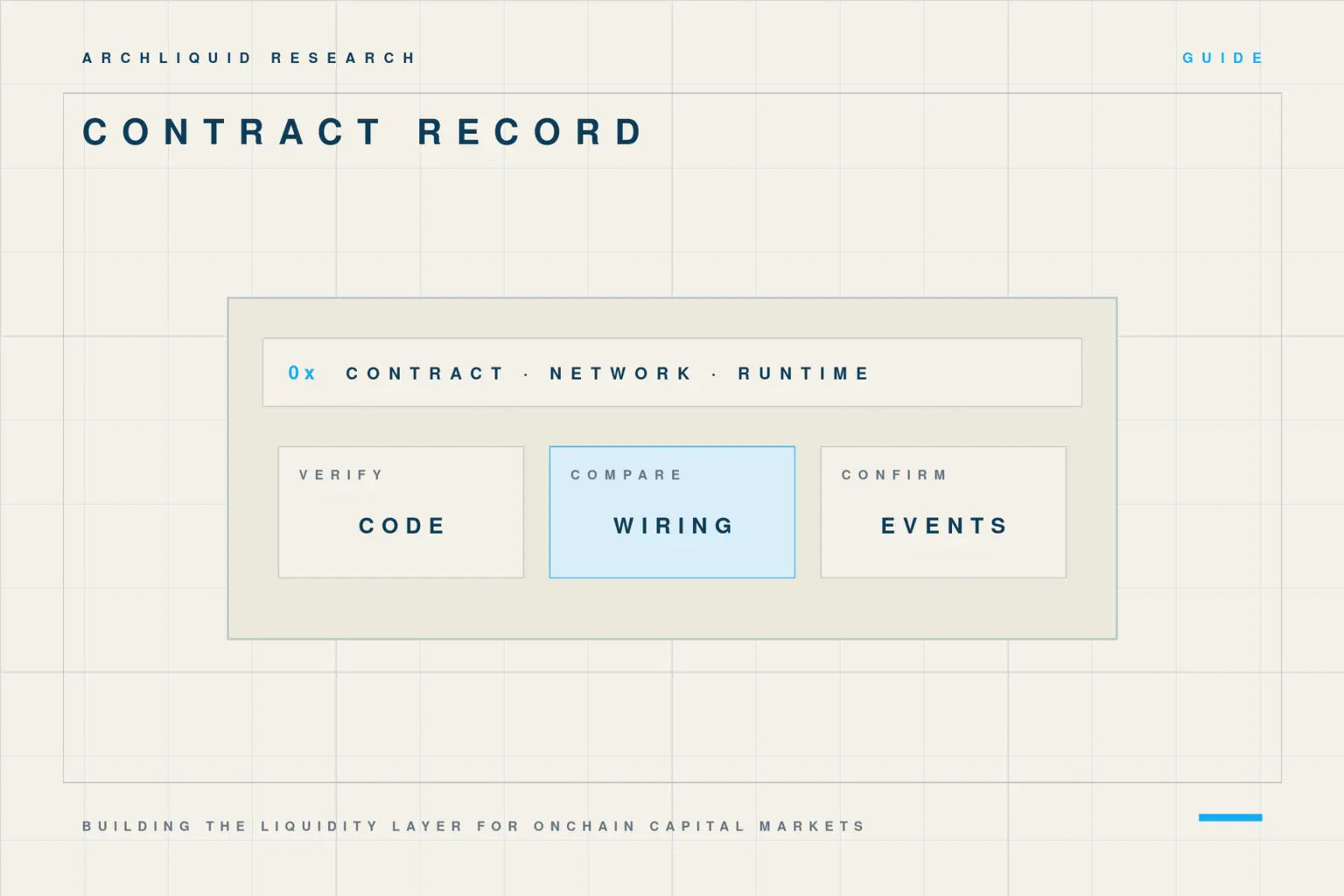
Key takeaways
- Confirm the explorer network and checksummed address before interpreting any label, token name or transaction.
- Verified source helps explain bytecode, but proxy users must also inspect the current implementation and upgrade authority.
- Events and transaction input reveal state changes; current onchain reads are needed to confirm present ownership and roles.
From an address to a reviewable contract record
A disciplined review begins with network and code, then connects verified source or runtime evidence to proxy wiring, state-changing transactions, emitted events and current reads.
- 1. Identity
- Chain ID + address
- 2. Code
- Runtime + source status
- 3. Wiring
- Implementation + roles
- 4. History
- Calls + events
A label or ticker is not enough.
Note full, partial or absent verification accurately.
Inspect proxies and administrative authorities.
Decode the transactions that created current state.
This inspection flow applies to a selected contract; explorer labels are not endorsements of that contract.
Source: Blockscout user guide (Blockscout Documentation).
Confirm the explorer and address
Robinhood publishes separate mainnet and testnet explorer URLs. Begin by checking that the page belongs to the intended network, then compare the full checksummed address with the project's canonical release manifest or issuer registry. Similar symbols and shortened addresses can hide a wrong contract.
The overview should show whether code exists, the creation transaction when indexed and the current native balance. A contract label supplied by the explorer or a third party is navigation help, not proof of identity or safety.
Interpret source-verification status precisely
When source is verified, the explorer can map deployed bytecode to compiler inputs and present readable code and ABI. Review compiler version, optimizer settings and constructor arguments where available. A verification badge does not prove the logic is correct or the deployed configuration is safe.
If verification is partial or absent, record that limitation. Runtime bytecode and creation input can still support comparison with an archived build, but the result should not be described as a full metadata match unless all inputs agree.
Trace proxies to the code users execute
A proxy forwards calls to an implementation. Reading only the proxy source explains forwarding but not the application logic. Follow the implementation link or storage-derived address, verify its code and identify the administrator or upgrade authority.
Check upgrade events and current implementation state. A historical audit can apply to an old implementation while the proxy now points elsewhere. Timelock and multisig evidence belong in the same review because they determine how implementation changes can occur.
Use transactions and logs together
A state-changing transaction shows sender, target, value, calldata, receipt status and gas. Decoded input explains the attempted function call. Event logs record what the contract emitted. Neither should be read alone: a successful transaction can call multiple contracts and one action can emit several related events.
For a locker, connect the creation event to the transferred token and receipt owner. For an access-control change, compare the role event with a current role read. Explorer indexes can lag or omit decoded context, so live contract reads settle present state.
Build a small evidence bundle
Record chain ID, address, deployment transaction, block number, runtime hash, compiler evidence, implementation, role owners and important dependency addresses. Link the exact explorer pages and primary registry sources. This bundle is more useful than a screenshot because each item can be independently checked.
Explorers can change interfaces and indexing status. Preserve release artifacts outside the explorer and use RPC reads in monitoring. Blockscout is a powerful lens over the chain; the chain state and archived build inputs remain the durable technical record.
Sources and further reading
Sources were accessed for this publication on August 4, 2026. Product terms, networks and deployments can change; check the linked primary source before acting.
Related reading
Robinhood Stock Token API Integration: Assets, Prices and Corporate Actions
The API exposes identity, market data and lifecycle events, but raw REST quotes and onchain feed values require different multiplier handling.
Robinhood Chain Testnet Transactions: Wallet, Gas, Explorer and Revert Checks
A connected wallet is not yet ready to transact. Network, signer, gas, contract code and simulation must all agree before the request is meaningful.
Real-World Asset Tokenization: What It Is and What It Does Not Change
Tokenization can make an asset programmable. It cannot, by itself, create ownership rights, remove counterparties, or make an illiquid market liquid.