Robinhood Chain Governance: Council Thresholds, Timelocks and Validators
Chain governance defines who can change the system and how quickly. The published thresholds are useful only when their different powers are kept distinct.
Key takeaways
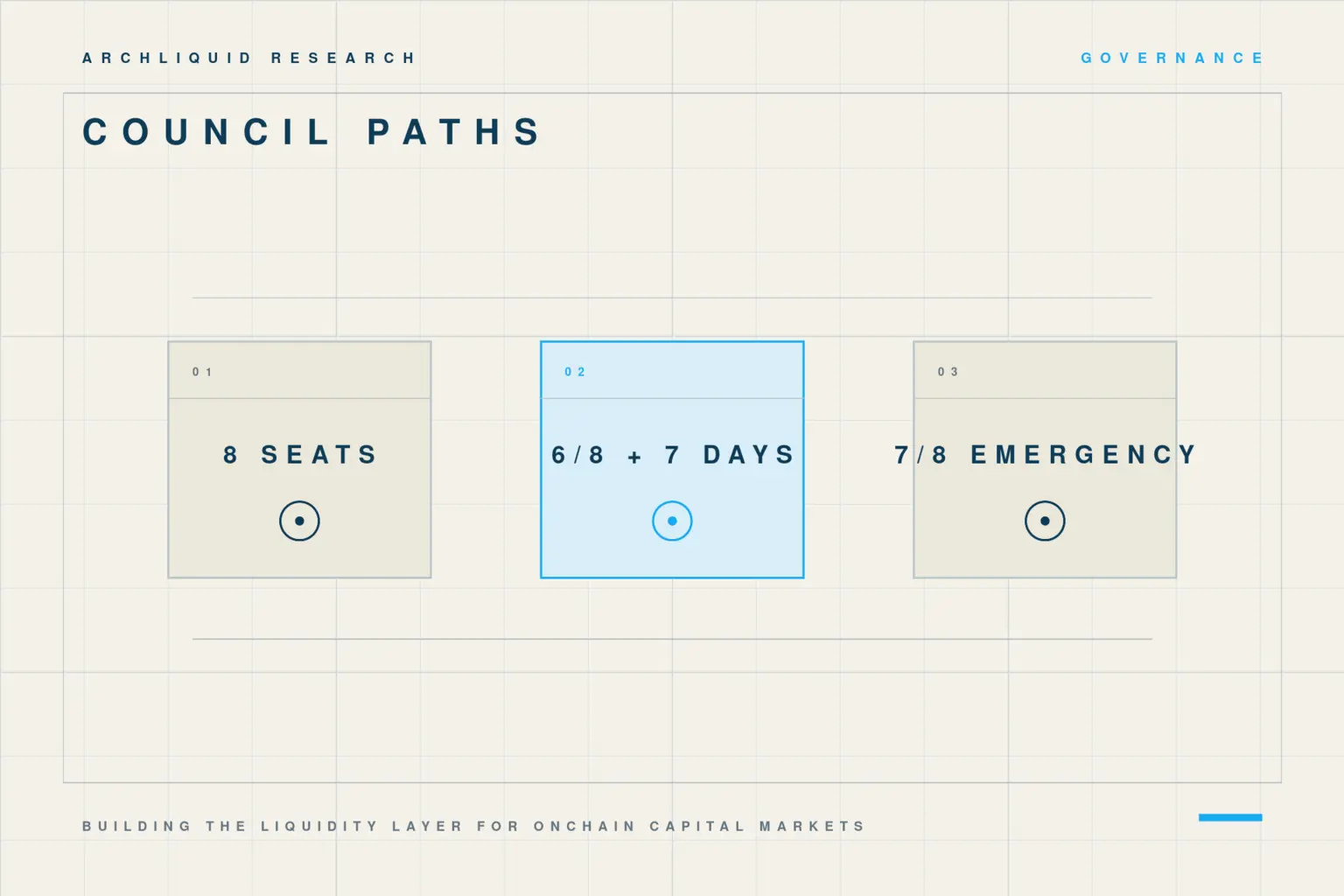
- Robinhood documents eight council seats, with two held by Robinhood and six independent signers.
- Routine actions require six of eight approvals plus a seven-day timelock; emergencies require seven of eight without the delay.
- Application-level upgrade and pause roles remain separate from chain governance and must be reviewed independently.
Routine and emergency paths optimize for different risks
A routine change favors notice and review; an emergency path favors rapid response with a higher signer threshold. Neither path describes an application's own admin keys.
- Council
- 8 seats
- Routine
- 6 of 8 + 7 days
- Emergency
- 7 of 8
- Current validators
- 2 documented
Two Robinhood seats and six independent seats in the published model.
Threshold plus timelock before execution.
Higher threshold, with no timelock.
Offchain Labs and Alchemy are named in the governance page.
Source: Robinhood Chain governance (Robinhood Chain Documentation).
What the council controls
Robinhood Chain publishes a Security Council model with eight signers. Two seats are held by Robinhood and six are described as independent. The page frames the council as the authority for upgrades and emergency actions. This is a concrete governance dependency, not an abstract claim that the chain governs itself.
For users and builders, the central question is not whether governance exists but which changes each path can execute. Upgrade authority, emergency intervention and validator participation affect different failure modes. Reviews should map the documented chain controls beside the application contracts that run on the chain.
Routine changes use delay as a control
The routine path requires six of eight council signatures and a seven-day timelock. A threshold reduces the risk that one key acts alone, while the timelock creates a window in which integrators can inspect the queued change, alert users and adjust exposure before execution.
A timelock is valuable only if proposals are visible and decoded. Monitoring should identify the target, calldata, scheduled execution and affected system. A seven-day delay does not help a user who cannot tell that an upgrade changes bridge verification or fee logic until after it executes.
Emergency changes trade delay for a higher threshold
Robinhood's documented emergency path requires seven of eight approvals and has no timelock. The design raises the consensus threshold while allowing rapid action. That tradeoff is intended for incidents where waiting could increase harm, but it also means observers can have little or no advance reaction time.
An emergency authority should be evaluated by scope. Pausing a vulnerable route can contain losses; replacing arbitrary logic can introduce a different class of risk. Public post-incident records, signer security and narrowly defined powers all matter beyond the headline signature count.
Validators and fraud-proof participation
The governance documentation describes permissioned validators and names Offchain Labs and Alchemy as the current validators. It also references BoLD, Arbitrum's dispute protocol. Permissioned participation means the operational validator set is a stated trust and resilience assumption that applications should disclose accurately.
A chain's validator model should not be confused with an application's oracle set, multisig or keeper. A lending protocol can be deployed on a functioning chain and still fail because its own price or admin controls are weak. Risk maps are clearer when each operator and threshold appears as a separate boundary.
How applications should communicate governance
A protocol interface should link the chain governance source and separately identify its own upgrade, pause and treasury roles. If a contract is immutable, state which dependencies can still change. If it is upgradeable, disclose the implementation, administrator, signature threshold and timelock rather than using a generic secured-by-multisig badge.
Governance facts can change. Publication dates and periodic verification prevent a once-correct council description from becoming permanent marketing copy. The best user-facing summary stays short, while a deeper evidence page preserves addresses, events and current role holders.
Sources and further reading
Sources were accessed for this publication on August 4, 2026. Product terms, networks and deployments can change; check the linked primary source before acting.
Related reading
Robinhood Chain Explained: Architecture for Onchain Capital Markets
Robinhood Chain combines Ethereum-compatible execution with dedicated market infrastructure for tokenized assets. Here is what the architecture actually provides.
Bridging RWAs to Robinhood Chain: Routes, Finality and Risk
A bridge does more than move a balance between interfaces. It changes the custody, message-finality and contract assumptions around that balance.
Robinhood Chain Network Configuration: Mainnet, Testnet, RPC and Explorer
A wallet network is more than an RPC URL. Chain ID, explorer, native currency and endpoint reliability must agree before a transaction is safe to request.