Source Verification and Bytecode Matching for Onchain Market Infrastructure
Published source is useful only when users can connect it to the exact bytecode, network and configuration that holds assets.
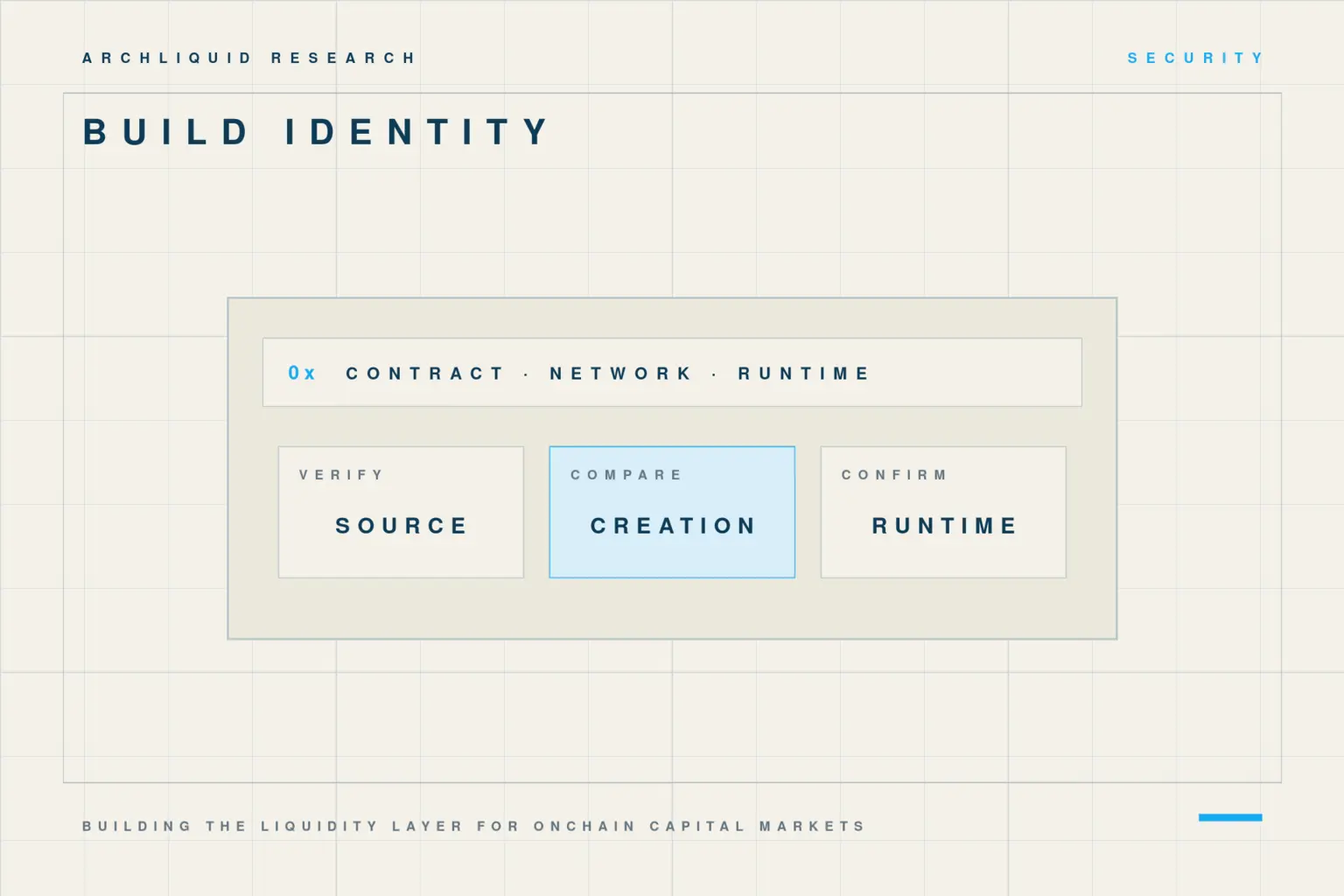
Key takeaways
- Source verification must target the exact address and chain that users rely on.
- Compiler version, optimizer settings, linked libraries, constructor arguments and metadata affect the result.
- Proxy verification must include the current implementation and upgrade authority, not only the proxy shell.
Matching source requires more than matching Solidity text
Compiler version, optimizer settings, source paths, metadata, libraries and constructor arguments all participate in deployment identity. A release bundle preserves the exact inputs instead of reconstructing them later.
- Compiler
- Version + EVM target
- Optimizer
- Enabled + runs
- Deployment
- Constructor input
- Live contract
- Runtime hash
Different toolchains can produce different output.
Settings change bytecode generation.
Creation bytecode and arguments establish initial state.
Useful comparison, but not the complete creation record.
Source: Uniswap V4 deployments (Uniswap Developers).
What source verification answers
A block explorer can associate human-readable source with deployed contract bytecode. A full match gives reviewers a practical way to inspect functions, events, constructor inputs and compiler settings for the address users call. It reduces the chance that public source describes a different build than the contract holding assets.
Verification does not prove that the logic is safe. A verified contract can contain a vulnerability, unsafe admin power or malicious behavior. It also does not certify economic assumptions. Verification answers an identity question: does this submitted build correspond to this deployment under the explorer's matching rules?
Why exact build inputs matter
Solidity output depends on the compiler version, optimizer status and run count, EVM target, library addresses, source paths and metadata configuration. Constructor arguments are appended to creation input. A small difference can prevent a full metadata match even when the runtime logic appears similar.
Teams should archive a standard compiler input, dependency lockfile, creation transaction and constructor encoding for every release. Rebuilding from those artifacts is stronger than reconstructing settings after deployment. It also makes independent comparison possible when an explorer is unavailable.
Creation bytecode and runtime bytecode
Creation bytecode runs once and returns the runtime code stored at the address. Constructor logic and arguments affect deployment but are not all present in runtime code. Comparing only runtime hashes is valuable for detecting logic changes, yet it may not prove which constructor values or initialization path produced the live state.
A complete evidence record combines the transaction input, receipt, deployed runtime hash, decoded constructor or initializer values and current immutable or public wiring. Where metadata differs, teams should state whether the match is exact, partial or an independently reproduced runtime match instead of collapsing those outcomes into a single verified label.
Proxies and upgradeable systems
A proxy forwards calls to an implementation. Verifying the proxy source reveals the forwarding mechanism but not the business logic users execute. Reviewers also need the current implementation address, its verified source, the upgrade administrator and any timelock or multisignature policy.
Because implementations can change, verification is a monitoring problem as well as a release task. Index implementation-upgrade events, alert on unexpected changes and preserve each historical runtime hash. Interfaces should avoid implying immutability when an authorized role can replace logic.
A public evidence bundle
For each contract, publish the chain ID, checksummed address, deployment transaction, block number, compiler input, source repository revision, constructor arguments, runtime hash and explorer status. Add role owners and dependency addresses. If the deployed build uses proprietary metadata or code, the public statement still needs to distinguish reproducible evidence from unavailable source.
RWA infrastructure deserves this precision because contracts may custody liquidity, vesting allocations or collateral whose offchain meaning is already complex. Exact deployment evidence gives users and integrators one stable technical layer on which to base further legal and market review.
Sources and further reading
Sources were accessed for this publication on August 4, 2026. Product terms, networks and deployments can change; check the linked primary source before acting.
Related reading
Why Canonical Contract Addresses Matter for Stock Tokens and LP Positions
Ticker symbols and token interfaces are easy to imitate. Canonical identity comes from an authoritative registry plus live onchain verification.
ERC-20 Approvals for Stock Tokens: Allowances, Permissions and Safer UX
An approval does not move a token. It authorizes a spender to move up to an allowance later, which makes spender identity and scope critical.
Multisig and Timelock Governance for RWA Protocols: Roles and Response Paths
A multisig reduces single-key control; a timelock adds notice. Neither helps if one broadly privileged role can bypass the intended path.