Multisig and Timelock Governance for RWA Protocols: Roles and Response Paths
A multisig reduces single-key control; a timelock adds notice. Neither helps if one broadly privileged role can bypass the intended path.
Key takeaways
- Multisignature wallets require a threshold of owners and protect against one compromised key, but signer independence still matters.
- Timelocks create a review window for routine changes and need visible queued-action monitoring.
- Emergency roles should have narrow powers and a documented recovery path instead of unrestricted upgrade authority.
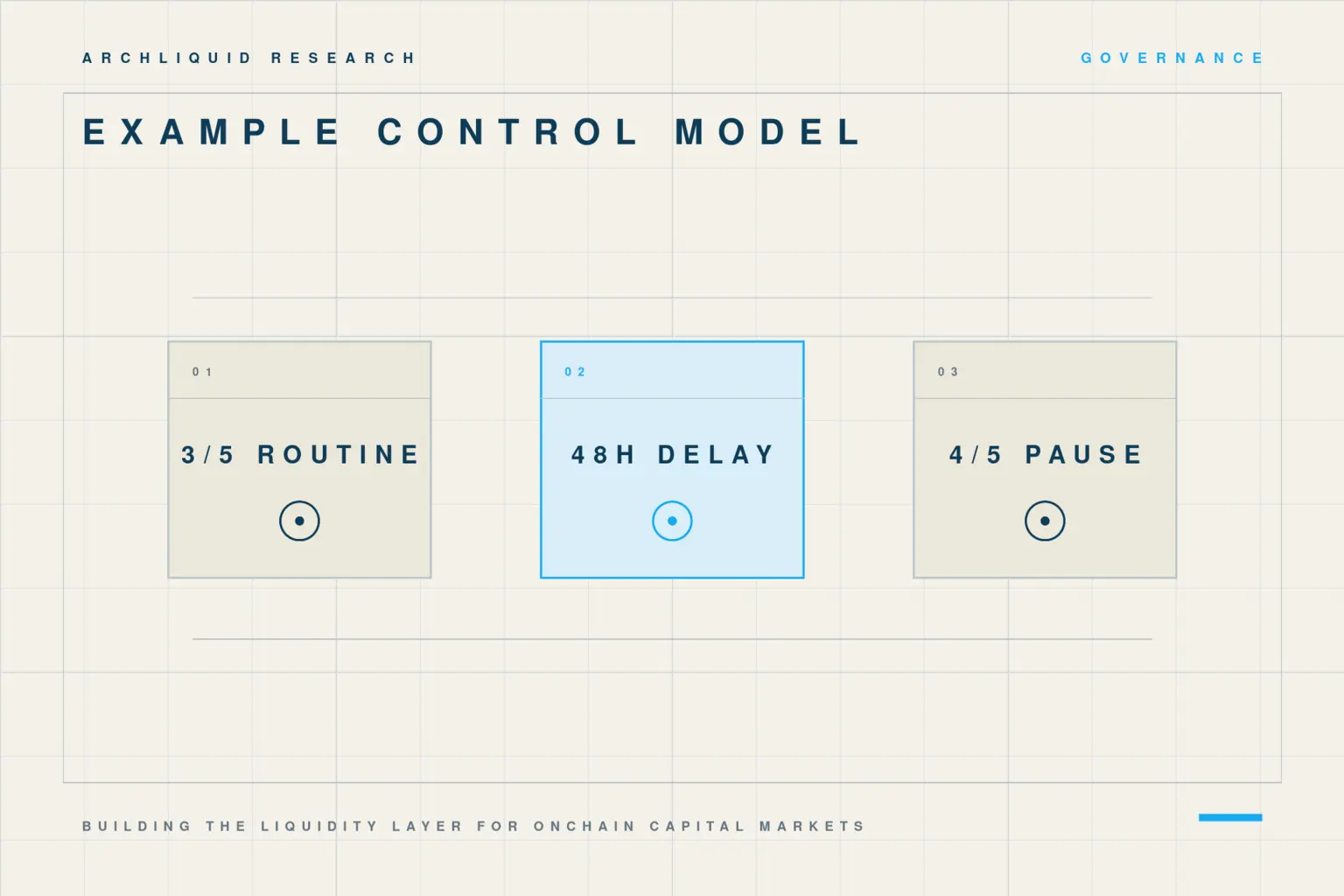
Routine upgrade through 3-of-5 plus 48 hours; emergency pause through 4-of-5
This illustrative design makes routine upgrades visible before execution and gives an emergency council only pause authority. Unpause or logic replacement returns to the delayed route.
- Routine proposal
- 3 of 5
- Execution delay
- 48 hours
- Emergency pause
- 4 of 5
- Recovery
- Delayed route
Hypothetical multisig threshold.
Illustrative monitoring and exit window.
Higher threshold with bounded pause-only power.
Unpause or upgrade follows routine governance.
Illustrative application design. It is not Robinhood Chain governance or a statement of current ArchLiquid production roles.
Start with a map of powers
List every action that can change user outcomes: upgrading logic, pausing transfers, changing oracle addresses, listing collateral, moving treasury funds and rescuing tokens. Assign each to a named role rather than beginning with one owner account and hoping to distribute it later.
OpenZeppelin's access-control guidance distinguishes ownership from role-based authority. The least-privilege goal is practical: a compromised oracle-admin key should not also withdraw custody assets, and an emergency pause role should not silently replace implementation code.
A multisig changes the failure threshold
A multisignature wallet requires a configured number of owners to approve an action. A two-of-three setup, for example, can tolerate one unavailable signer and prevents one signer from acting alone. The improvement depends on owners using independent devices, custody arrangements and recovery processes.
Five keys held in one password manager are not five independent controls. Publish the threshold and identify organizations or signer classes where appropriate without exposing sensitive operational details. Monitor owner and threshold changes as governance events.
A timelock makes routine power observable
A timelock queues an approved action for future execution. The delay lets users and integrators decode calldata, evaluate consequences and react before the change takes effect. It also reduces pressure to trust an announcement that may not match the exact transaction.
Monitoring should surface target addresses, function selectors, parameters and earliest execution time. The timelock itself needs controlled proposers and executors. A bypass route with equivalent power defeats the user protection even when the primary administrator appears delayed.
Constrain the emergency path
Waiting through a delay during an active exploit can increase losses, so systems often retain an emergency path. The safest scope is narrow and reversible, such as pausing a vulnerable action. An emergency key with arbitrary upgrade authority can create the same catastrophic outcome it is meant to prevent.
Define how the system returns to normal. Require the delayed route for unpause or repair, publish an incident record and test the pause against every user path. Users may still need repayment, withdrawal of unaffected assets or access to accrued records while new risk is stopped.
Chain governance and protocol governance are separate
Robinhood Chain publishes its own council thresholds and validator model. A protocol deployed there retains independent application roles. A chain upgrade cannot explain who can change a lending oracle, and a protocol multisig cannot control the chain's bridge or sequencer.
Public architecture should show both layers. Release manifests record application role addresses, while chain documentation describes the underlying network. Keeping them separate prevents security claims from borrowing credibility across unrelated control boundaries.
Sources and further reading
Sources were accessed for this publication on August 4, 2026. Product terms, networks and deployments can change; check the linked primary source before acting.
Related reading
Why Canonical Contract Addresses Matter for Stock Tokens and LP Positions
Ticker symbols and token interfaces are easy to imitate. Canonical identity comes from an authoritative registry plus live onchain verification.
Source Verification and Bytecode Matching for Onchain Market Infrastructure
Published source is useful only when users can connect it to the exact bytecode, network and configuration that holds assets.
ERC-20 Approvals for Stock Tokens: Allowances, Permissions and Safer UX
An approval does not move a token. It authorizes a spender to move up to an allowance later, which makes spender identity and scope critical.